For privacy-first individuals who want a private assistant on their own machine, there are several notable OpenWebUI alternatives. For teams needing governed enterprise search, Onyx is a common choice. For multi-provider chat with a ChatGPT-style interface, LibreChat is popular. For document Q&A, AnythingLLM is suitable, and for visual workflow building, Flowise is recommended. This list ranks entrants by deployment model and data control, not by feature count alone.
TL;DR:
- GreenCube runs entirely on Windows with local inference using llama.cpp, requiring no server, Docker, or ongoing maintenance, and costs a one-time fee.
- Onyx is designed for organizational use, supporting over 40 connectors and permission-aware retrieval, with a high setup barrier for enterprise deployment.
- LibreChat offers a multi-provider, ChatGPT-style interface with easy one-command installation suitable for self-hosted environments, balancing flexibility and ease of use.
- Desktop-native tools like Jan, LM Studio, GPT4All, and Msty provide quick, low-setup solutions for individual users seeking offline AI without server management.
- The choice to replace OpenWebUI should depend on permission control needs and enterprise features, with market focus shifting toward governed RAG platforms and workflow builders.
Table of Contents
- What Are the Best OpenWebUI Alternatives Right Now?
- How Do You Choose the Right OpenWebUI Alternative?
- When Should You Actually Replace OpenWebUI?
- Get GreenCube: A Fully Local AI Assistant for Windows
- Sources
- FAQ
What Are the Best OpenWebUI Alternatives Right Now?
OpenWebUI earned its popularity as a flexible, self-hosted chat front end for Ollama and other local runners. But "flexible" cuts both ways: it demands Docker knowledge, a server you maintain, and a willingness to configure embedding engines yourself if you trim down to a slim build. That last part trips people up more than it should. The official documentation warns that slim installs strip out pre-bundled models and retrieval features, which means a user chasing a smaller footprint can accidentally lose document chat entirely.
That gap is exactly why the alternatives market has split into distinct lanes rather than one crowded field of clones. Open WebUI's own alternatives page groups the ecosystem into local runners (Ollama, llama.cpp), desktop apps (LM Studio, Jan), enterprise platforms, and cloud services. Independent roundups reach similar conclusions: Budibase's comparison sorts tools by use case rather than by who has the most GitHub stars, and that is the right instinct to copy.
Here is how the 19 leading OpenWebUI alternatives stack up on the factors that actually decide whether a deployment survives contact with real users.
| Tool | Best for | Deployment | License / pricing | Local model support | Enterprise features | Setup barrier |
|---|---|---|---|---|---|---|
| GreenCube | Privacy-first single users, offline analysis | Desktop (Windows) | One-time, €8.99 / $9.99 | Built-in local inference (llama.cpp) | None (single-user product) | Low |
| Onyx | Teams needing governed enterprise search | Self-hosted / cloud / air-gapped | Community + enterprise tiers | Yes, via connectors | 40+ connectors, permission-aware RAG | Moderate to high |
| LibreChat | Multi-provider chat, ChatGPT-like UI | Self-hosted | Open source | Yes (Ollama, local APIs) | Auth, plugins, multi-provider routing | Moderate |
| AnythingLLM | Team document Q&A and RAG | Desktop / self-hosted | Open source + hosted option | Yes (Ollama, LM Studio) | Workspace permissions | Low to moderate |
| Jan | Individuals wanting a lightweight local app | Desktop | Open source | Native, built-in | None | Low |
| LM Studio | Model discovery and desktop model runs | Desktop | Free | Native, built-in | None | Low |
| Text Generation WebUI | Developers needing backend/runtime control | Self-hosted | Open source | Extensive backend support | None | High |
| GPT4All | Minimal local docs and chat | Desktop | Open source | Native, built-in | None | Low |
| Chatbox | Mobile-friendly local/cloud client | Desktop / mobile | Free + paid tiers | Yes, connects to local APIs | None | Low |
| Flowise | Visual agent and workflow building | Self-hosted / cloud | Open source + cloud | Yes, via nodes | Workflow permissions | Moderate |
| PrivateGPT | Custom private RAG pipelines | Self-hosted | Open source | Yes, framework-level | Depends on implementation | High |
| HuggingChat | Testing hosted open models | Cloud | Free | No (hosted models) | None | Low |
| LobeChat | Self-hosted multi-model chat with plugins | Self-hosted / cloud | Open source | Yes, via API connections | Plugin marketplace | Moderate |
| Chatbot UI | Open-source ChatGPT-style front end | Self-hosted | Open source | Yes, via API | Basic auth | Moderate |
| Msty | Consumer-friendly local + cloud chat | Desktop | Free + paid | Native, built-in | None | Low |
| BionicGPT | Enterprise self-hosted AI gateway | Self-hosted / air-gapped | Open source + enterprise | Yes, via connections | RBAC, team management | Moderate to high |
| Hollama | Minimal local chat client | Desktop / self-hosted | Open source | Yes (Ollama-native) | None | Low |
| Budibase | App builder with AI agent features | Self-hosted / cloud | Open source + paid tiers | Limited, via integrations | Permissions, app hosting | Moderate |
| Text Generation WebUI (Text Gen UI) | Fine-grained model experimentation | Self-hosted | Open source | Extensive | None | High |
A few of these deserve more than a table row.
GreenCube runs entirely on the user's Windows PC with local inference through llama.cpp, no Docker, no server to babysit, and no monthly bill. It skips the deployment complexity that trips up everyone else on this list because there is no deployment. You download one model once, and the app just works from there.
Onyx is the opposite end of the spectrum: built for organizations that need retrieval to respect who can see what. Its own positioning leans on more than 40 native connectors and retrieval that inherits source permissions, which matters enormously for regulated data. A community chat UI rarely bothers checking whether a user should see a document before summarizing it. Onyx does.
LibreChat covers the middle ground: a self-hosted, ChatGPT-style interface that talks to multiple model providers at once. Libre WebUI makes a similar pitch for local-first, provider-flexible setups with a one-command install, which is worth checking if LibreChat's Docker footprint feels heavier than you want.
AnythingLLM exists for one job: point it at a folder of PDFs and start asking questions. It integrates with Ollama and LM Studio as backends, so teams already running local models don't have to switch runners.
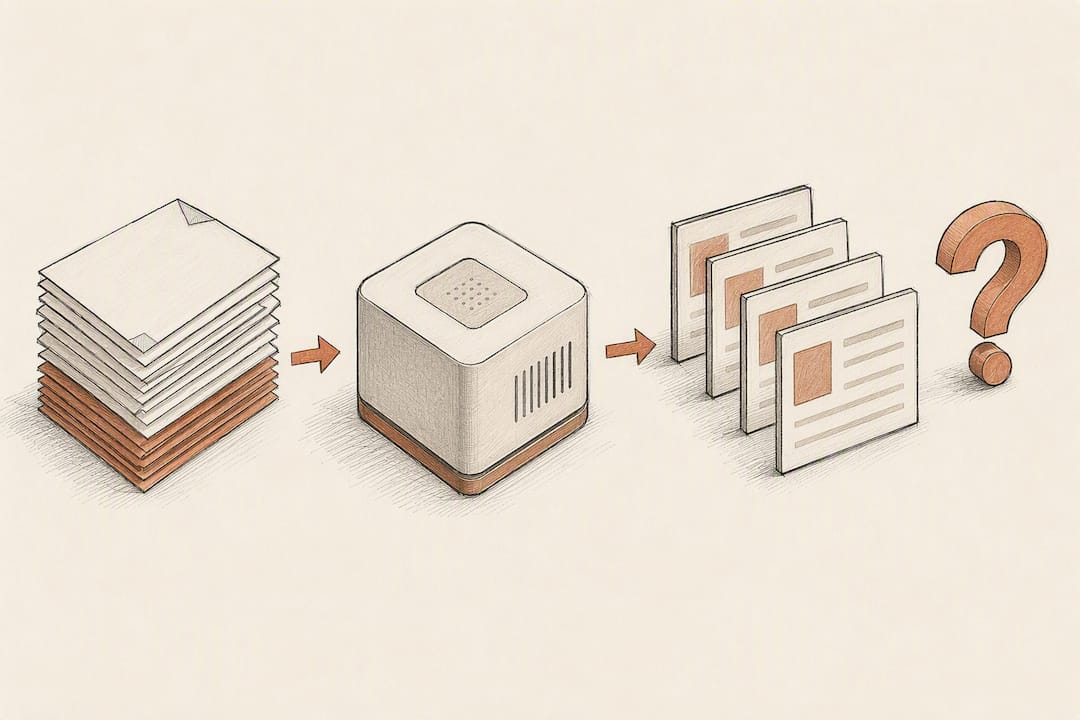
Jan, LM Studio, GPT4All, Msty, and Hollama occupy the desktop-native lane. None require a browser tab pointed at localhost or a Docker Compose file. That lower barrier is a real trade for individuals who want local inference without server administration, though it comes at the cost of the multi-user features Onyx and BionicGPT offer.
Flowise, Budibase, and PrivateGPT target builders. Flowise gives you a drag-and-drop canvas for agent pipelines. PrivateGPT hands you a framework instead of a UI, better suited to engineers writing custom ingestion logic than to someone who just wants a chat window. Budibase leans toward teams building internal apps with AI features bolted on rather than a standalone chat replacement.
Text Generation WebUI and its variant Text Gen UI sit at the developer-heavy end. Helicone's comparison notes it supports more backends and finer runtime control than most competitors, but that flexibility demands stronger local hardware and a real setup investment. This is the tool for someone who wants to tune sampling parameters at 2 a.m., not someone who wants a working assistant in ten minutes.
BionicGPT and LobeChat round out the enterprise and power-user middle: BionicGPT positions itself as an AI gateway with role-based access for organizations, while LobeChat adds a plugin marketplace on top of self-hosted multi-model chat. HuggingChat and Chatbot UI are worth a mention mainly for quick experimentation. HuggingChat lets you try community models hosted on Hugging Face's infrastructure without installing anything, and Chatbot UI gives developers a familiar open-source starting point to fork.
How Do You Choose the Right OpenWebUI Alternative?
Match the tool to your actual constraint, not to whichever name shows up most on forums. Run through this checklist before you commit:
- Does data need to stay on one machine, or can it live on a server you control? If the answer is "one machine, no exceptions," desktop apps like GreenCube, Jan, LM Studio, or Msty are your entire shortlist. Everything else assumes at least a self-hosted server.
- Do multiple people need access with different permissions? If yes, you're in Onyx or BionicGPT territory, not desktop-app territory. Check specifically whether connectors inherit source permissions. Not every enterprise platform does this correctly, and it's a critical difference for regulated data.
- Do you need SSO or LDAP for company login? This narrows things to Onyx, BionicGPT, and some self-hosted deployments of LibreChat. Desktop-native tools generally skip authentication because there's only one user.
- What's your air-gap requirement? Onyx and BionicGPT both support fully air-gapped deployment, which matters for government, defense, or healthcare environments where internet access to any external API is a non-starter.
- How much setup time can you realistically spend? Desktop apps: minutes. Self-hosted single-container deployments (AnythingLLM, LibreChat): an afternoon. Enterprise platforms with connector configuration (Onyx, BionicGPT): plan for days, not hours.
- Which local runners do you already use? If you've standardized on Ollama, check native compatibility first. Hollama, LibreChat, AnythingLLM, and GreenCube's own inference layer all work without friction here, while some enterprise platforms require additional connector setup to talk to local models at all.
Pro Tip: Don't default to your biggest, most expensive model for every task. A common optimization in the Open WebUI setup guidance is assigning a small, cheap model to background chores like title generation or tagging, saving your larger reasoning model for the questions that actually need it.
If your checklist answers point to "one user, one machine, sensitive documents," stop shopping. You've already found your category.
When Should You Actually Replace OpenWebUI?
OpenWebUI still makes sense if you want a flexible, self-hosted chat front end and don't mind maintaining the Docker container yourself. Its plugin ecosystem and Ollama integration remain genuinely good for hobbyists and small dev teams comfortable with server administration.
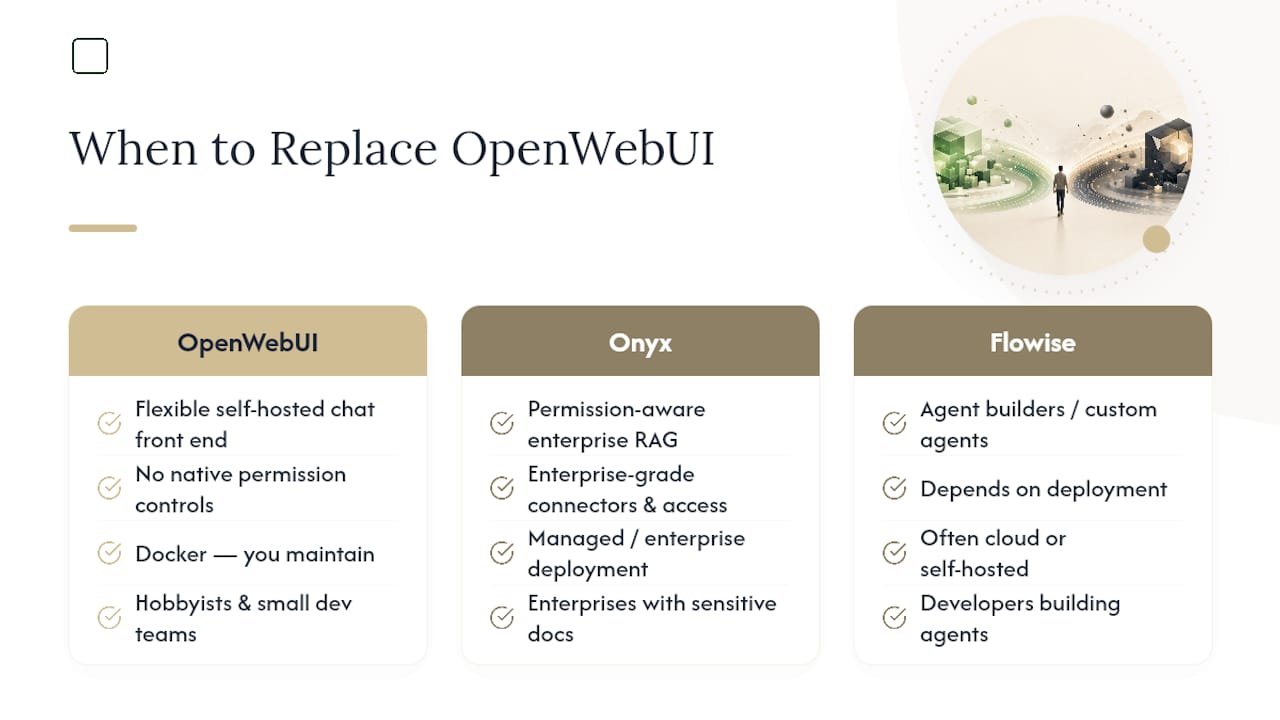
The calculus changes the moment permissions enter the picture. If a document should be visible to finance but not to marketing, a community chat UI has no native way to enforce that. That's when enterprise-grade connectors and permission-aware retrieval, the lane Onyx occupies, stop being a nice-to-have and become the actual requirement.
Expect the market to keep splitting further into agent builders (Flowise's lane) and governed RAG platforms (Onyx's lane), while desktop-native tools quietly keep winning the individual user who never wanted a server in the first place.
— Greencube
Get GreenCube: A Fully Local AI Assistant for Windows
If everything above tells you one thing, it's that most OpenWebUI alternatives still ask you to run a server, manage Docker, or trust a cloud provider with your files. Greencube skips all three. It's a desktop app that installs on Windows 10 or 11 and runs its AI model directly on your hardware using llama.cpp, so your chats and documents never leave your PC.
Setup takes one download. Pick "Quick" or "All-rounder" versions, with higher RAM recommended for more advanced usage. Only certain model options handle image understanding. Sign-in through Google or Microsoft is required once for license verification; chat data stays local to the device. Checkout uses Stripe. GreenCube is offered for a one-time price with no subscription or usage caps. If you're weighing local model requirements against your current hardware, this guide to how local AI works on your laptop walks through what to expect. When you're ready, buy GreenCube Lifetime and start chatting offline today.
FAQ
What are the best OpenWebUI alternatives for teams in 2026?
For teams, Onyx leads on enterprise connectors and permission-aware retrieval, LibreChat covers multi-provider chat needs, and Flowise fits teams building agent workflows rather than a straight chat interface.
Is LibreChat better than OpenWebUI?
LibreChat and OpenWebUI both self-host and support multiple providers, but LibreChat leans more heavily into ChatGPT-style UI features like Artifacts and plugin support, while OpenWebUI leans on tighter Ollama integration.
What's the difference between Ollama and OpenWebUI?
Ollama runs and serves local models on your machine; OpenWebUI is the chat interface that sits on top of it. You generally need both, or a similar runner paired with a front end like GreenCube, LibreChat, or LM Studio.
Does GreenCube work like OpenWebUI?
Both offer a chat interface over local models, but GreenCube runs as a standalone Windows desktop app with no server or Docker setup, priced as a one-time €8.99 / $9.99 purchase rather than a self-hosted open-source project.
Which OpenWebUI alternative needs the least technical setup?
Desktop-native apps: GreenCube, Jan, LM Studio, GPT4All, and Msty all install directly on your computer without Docker or a server, typically running within minutes of download.