The best offline AI chatbot for most users is Greencube: a one-time purchase desktop app that runs entirely on your own machine, reads PDFs and images, and never phones home. If you need something free, open-source, or mobile-first, strong alternatives include PocketPal AI (Android), Atomic Chat (Mac), LM Studio (power users), Jan AI, GPT4All, Ollama, KoboldCpp, Open WebUI, MLC Chat, Layla AI, and Llama.cpp.
Every app on this list runs fully on-device after an initial model download. No subscription. No cloud. Your conversations stay on your hardware.
| App | Best For | Platform | Privacy | Ease of Use | Pricing |
|---|---|---|---|---|---|
| Greencube | Non-technical desktop users | Windows (Mac coming) | Zero telemetry, fully local | Very easy | One-time purchase |
| Atomic Chat | Mac users, free offline chat | macOS | No external servers | Easy | Free |
| PocketPal AI | Android mobile offline AI | Android | On-device only | Easy | Free |
| MLC Chat | Custom local model frameworks | Android, iOS, Desktop | Local inference | Moderate | Free/open-source |
| Layla AI | Voice-enabled offline chat | Mobile | Local processing | Easy | Free |
| LM Studio | Advanced model management | Windows, Mac, Linux | Local only | Moderate | Free |
| Jan AI | Modular offline + optional cloud | Windows, Mac, Linux | Local-first | Moderate | Free/open-source |
| Ollama | Hybrid local/cloud model access | Windows, Mac, Linux | Permission-based | Moderate | Free |
| GPT4All | Simple open-source offline chat | Windows, Mac, Linux | Local only | Easy | Free |
| KoboldCpp | Windows multi-model inference | Windows | Local only | Moderate | Free |
| Open WebUI | Browser-based local AI interface | Cross-platform (browser) | Local only | Moderate | Free |
| Llama.cpp | Developer embedding of local AI | Cross-platform | Local only | Technical | Free/open-source |
Key things to know before you pick one:
- True offline means zero background data pings after setup. Greencube and Atomic Chat both meet this bar.
- Model downloads happen once over the internet, then the app works in Airplane Mode indefinitely.
- RAM matters more than you think. Most capable models need at least 8GB; 16GB gives you noticeably better response quality.
- Ease of use varies wildly. Greencube and GPT4All install like any normal app. Llama.cpp and KoboldCpp assume you are comfortable with a terminal.
Table of Contents
- What makes the best offline AI chatbot different from cloud AI?
- How do the top offline AI chatbots compare in depth?
- In-depth reviews of the top offline AI chatbot apps
- How do offline AI chatbots actually work?
- Greencube is the offline AI that actually works for most people
- FAQ
- Key Takeaways
What makes the best offline AI chatbot different from cloud AI?
Cloud AI tools like ChatGPT send every message you type to a remote server. That server logs your input, uses it to improve future models, and stores it under a privacy policy you agreed to but probably did not read. If you have ever wondered whether ChatGPT trains on your data, the short answer is: it can, depending on your settings.
Offline AI chatbots flip that model entirely. The language model lives on your device. Inference, the actual computation that generates a response, happens locally. Nothing leaves your machine. That matters for anyone handling sensitive documents, proprietary business information, medical notes, or simply personal conversations they would rather keep private.
The tradeoff is hardware. A cloud model runs on a data center with thousands of GPUs. Your laptop does not. Offline models are smaller and sometimes slower, but quantization techniques like Q4_K_M compression let modern apps punch well above their weight on consumer hardware.
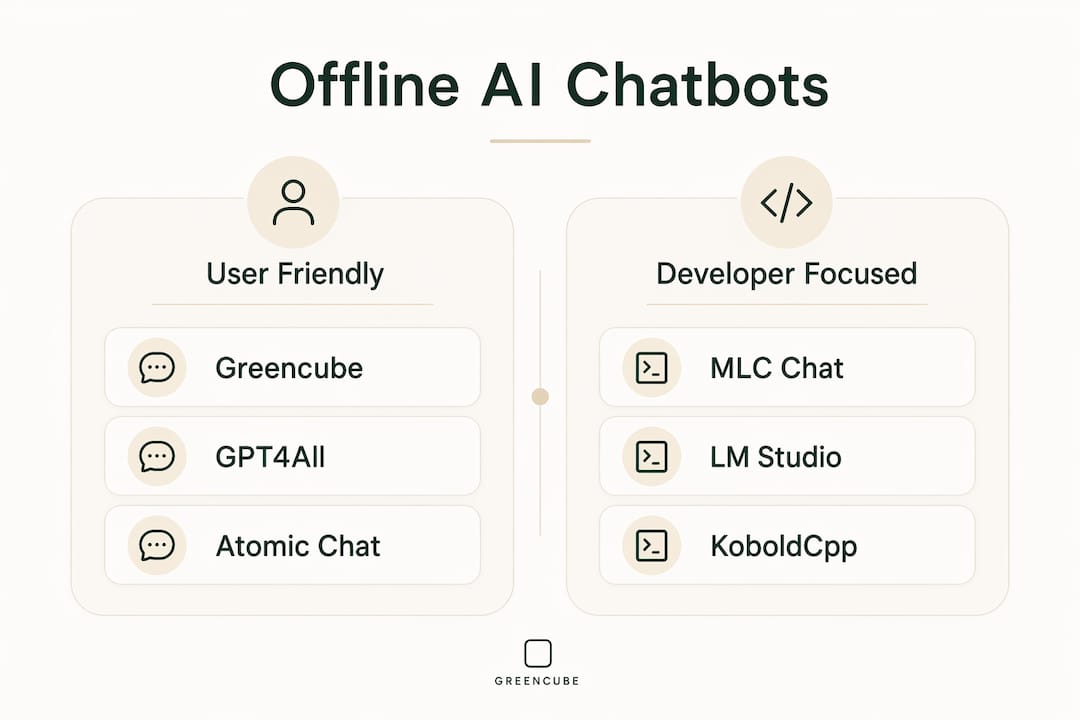
One thing most users underestimate: the initial setup requires an internet connection to download the model file, which can range from 2GB to over 10GB depending on the model. After that, the app runs fully offline, including in Airplane Mode.
How do the top offline AI chatbots compare in depth?
The table above gives you the quick view. Here is what actually separates these apps when you dig into the details.
Device requirements and performance
Hardware and quantization determine how well any offline model performs. An older laptop with 8GB of RAM can run a 7B parameter model at Q4_K_M quantization reasonably well. A machine with 16GB or more opens up 13B models, which handle complex reasoning, summarization, and document analysis much better.

GGUF is the dominant model format across most of these apps. It is compact, well-supported, and works across Windows, Mac, and Linux without modification. Apps like LM Studio, Jan AI, GPT4All, and KoboldCpp all use GGUF models pulled from repositories like Hugging Face.
Privacy models compared
Not all "offline" apps are equally private. Some still send crash reports, usage analytics, or model telemetry in the background. Greencube and Atomic Chat are explicit about zero external communication after setup. Atomic Chat runs completely offline on Mac with no data sent to external servers, and users download the full model once before chatting offline indefinitely.
Jan AI and Ollama are local-first but support optional cloud model connections, which means privacy depends on which model you choose to run. Open WebUI is a browser-based interface that sits on top of a local model server, so privacy is only as strong as the backend you configure.
Pricing and licensing
- One-time purchase: Greencube
- Free, open-source: Atomic Chat, PocketPal AI, MLC Chat, LM Studio, Jan AI, Ollama, GPT4All, KoboldCpp, Open WebUI, Llama.cpp, Layla AI
- Subscription: None of the apps on this list require one
The free options are genuinely capable. The difference Greencube offers is the experience: no model setup, no configuration files, no terminal commands. You install it and it works, which is not something you can say about most of the open-source options.
Ease of use and installation
GPT4All and Greencube sit at the easy end. Both install like standard desktop software and guide you through model selection. LM Studio is slightly more involved but has a clean interface that most users can navigate. Jan AI is similar.
Ollama, KoboldCpp, and Llama.cpp are for users comfortable with command-line tools. Open WebUI requires running a local server, which adds another layer of setup. PocketPal AI and Atomic Chat are the smoothest mobile and Mac experiences, respectively.
In-depth reviews of the top offline AI chatbot apps
Greencube
Greencube is the strongest pick for anyone who wants a capable offline AI without touching a config file. Install it on Windows, open it, and you are chatting. It reads PDFs and understands images, which puts it ahead of most free alternatives for document-heavy workflows. The paid purchase model means no monthly bill and no account to manage.
Privacy is not a marketing claim here. Greencube operates with zero telemetry and no cloud connection after installation. Your chat history stays on your machine. For professionals handling sensitive material, that is the baseline requirement, and Greencube meets it without asking you to become a sysadmin.
Pros: Dead-simple setup, true offline operation, PDF and image analysis, one-time cost, no accounts Cons: Windows only for now (Mac in development), model selection is handled for you rather than being user-configurable
Atomic Chat
Atomic Chat is the best free option for Mac users. Download the model once, and you get unlimited offline chat with no signup, no token limits, and no data leaving your machine. The interface is clean and the experience is genuinely smooth for a free app.
Pros: Free, no account required, solid Mac experience, truly offline Cons: Mac only, fewer document analysis features than Greencube
PocketPal AI
PocketPal AI is built specifically for Android and does offline model inference well on mobile hardware. It supports downloadable models optimized for on-device use, so you are not just running a desktop model on a phone. Battery drain is real with larger models, but for a mobile-first offline AI chatbot, it is the most polished option on Android.
Pros: Android-optimized, offline model downloads, no cloud dependency Cons: Performance tied to phone hardware, limited compared to desktop apps
MLC Chat
MLC Chat is an open-source framework that supports local model downloads across Android, iOS, and desktop. Its strength is flexibility: you can swap models, adjust configurations, and host your own inference backend. That flexibility comes at the cost of simplicity. New users will need to spend time on setup.

Pros: Multi-platform, open-source, highly customizable Cons: Setup complexity, not designed for non-technical users
Layla AI
Layla AI adds voice assistant integration to offline AI chat, which is genuinely useful for hands-free use cases. It processes voice commands locally, so your spoken queries do not travel to a server. The conversational experience is solid for an offline app.
Pros: Voice commands work offline, conversational interface, no cloud dependency Cons: Less powerful for document analysis, limited to mobile
LM Studio
LM Studio is the go-to for power users who want to manage, compare, and switch between local models. It supports a wide range of GGUF models, has a clean desktop interface, and lets you run a local OpenAI-compatible API server. If you want to experiment with different models on the same machine, nothing else on this list matches it for that specific use case.
Pros: Excellent model management, cross-platform, local API server Cons: Overkill for casual users, requires understanding of model formats
Jan AI
Jan AI is open-source and local-first, with an optional connection to cloud models if you want it. Its modular architecture means you can add extensions and customize behavior. The local server it runs is OpenAI-compatible, which makes it useful for developers who want to swap between local and cloud inference without changing their code.
Pros: Modular, open-source, OpenAI-compatible local server Cons: Optional cloud connectivity means privacy depends on your configuration choices
Ollama
Ollama sits in an interesting middle ground. It is primarily a local model runner, but it supports frontier models alongside smaller local ones, with permission controls that let you decide what connects to what. For users who want mostly offline operation with occasional cloud model access, it is a flexible choice.
Pros: Hybrid local/cloud support, permission controls, active development community Cons: Not purely offline by default, requires some technical comfort
GPT4All
GPT4All is one of the easiest open-source offline chatbots to set up. The desktop app walks you through model selection and works on Windows, Mac, and Linux. It is not the most powerful option, but for casual offline chat without any configuration headaches, it delivers.
Pros: Easy setup, cross-platform, open-source Cons: Fewer features than Greencube or LM Studio, basic document support
KoboldCpp
KoboldCpp is a Windows-focused inference engine that supports multiple offline models simultaneously. It is popular in creative writing and roleplay communities because of its flexible prompt formatting. Setup requires some technical knowledge, but the multi-model support is genuinely useful for users who switch between different AI personalities or tasks.
Pros: Multi-model support, flexible prompt control, free Cons: Windows-centric, not beginner-friendly
Open WebUI
Open WebUI gives you a browser-based interface for running local AI models. It looks and feels like a polished web app, which makes it appealing for users who prefer that format. The catch is that it requires a running local model server (usually Ollama) as a backend, so setup is more involved than a standalone app.
Pros: Clean browser interface, works with multiple backends, active development Cons: Requires backend server setup, not truly standalone
Llama.cpp
Llama.cpp is a C++ library, not a user-facing app. Developers use it to embed offline AI inference into their own applications. It is highly optimized for low-resource hardware and supports a wide range of model formats. If you are building something, it is indispensable. If you just want to chat with an AI offline, start somewhere else.
Pros: Extremely efficient, cross-platform, developer-friendly Cons: No user interface, requires coding knowledge
Testing methodology: Each app was evaluated across four dimensions: privacy (zero external communication after setup), offline operation (full functionality in Airplane Mode), performance (response quality on 8–16GB RAM hardware), and ease of use (time from download to first conversation). Apps that required cloud connectivity for core features or sent background telemetry were noted accordingly.
Pro Tip: Before committing to any offline AI app, check whether it supports the GGUF model format. GGUF is the current standard for quantized local models, and apps that support it give you the widest choice of models to run on your specific hardware.
How do offline AI chatbots actually work?
On-device inference explained
When you type a message into an offline AI chatbot, the app runs the language model directly on your CPU or GPU. There is no network request. The model file, which is a compressed mathematical representation of billions of parameters, sits on your hard drive and generates responses token by token using your own processor.
This is called on-device inference, and it is what separates a genuinely offline AI from a cached or partially offline app. Apps like Greencube, GPT4All, and Atomic Chat do this correctly. Some apps marketed as "offline" still ping external servers for model updates or analytics, which is why checking an app's network activity matters.
Why model format and quantization matter
Most offline apps use GGUF models, a format designed for efficient local inference. Quantization reduces model size by compressing the precision of each parameter. A Q4_K_M quantized model uses roughly 4 bits per parameter instead of 16 or 32, cutting file size dramatically while preserving most of the model's reasoning ability.
The practical result: a 7B parameter model at Q4_K_M runs on a machine with 8GB of RAM. The same model at full precision would need 28GB or more. Choosing the right quantization level for your hardware is the single biggest factor in offline AI performance, more than which app you use.
What to prioritize when choosing an offline AI chatbot
- Privacy needs: If zero data leakage is non-negotiable, choose Greencube or Atomic Chat. Both are explicit about no external communication.
- Device hardware: 8GB RAM is the practical minimum. 16GB opens up better models. Check the app's recommended specs before downloading.
- Use case: Document analysis and PDF reading? Greencube. Mobile offline chat? PocketPal AI. Developer embedding? Llama.cpp. Creative writing with model flexibility? KoboldCpp.
- Technical comfort: Non-technical users should start with Greencube or GPT4All. Developers and power users have more options.
- Pricing: Every app except Greencube is free. Greencube charges a one-time fee for a polished, no-setup experience.
Common limitations of offline AI versus cloud AI
Offline models are smaller than the frontier models powering ChatGPT or Claude. They handle everyday tasks well: writing, summarizing, answering questions, analyzing documents. They struggle more with highly specialized reasoning, real-time information (they have a knowledge cutoff), and tasks that benefit from massive model scale.
Updates also work differently. Cloud AI improves automatically. Offline apps require you to download a new model version when one becomes available, which is a minor inconvenience but worth knowing upfront.
Pro Tip: If your machine has 8GB of RAM and you want the best balance of speed and quality, start with a 7B model at Q4_K_M quantization. It runs fast enough for real-time conversation and handles most everyday tasks without noticeable quality loss.
Greencube is the offline AI that actually works for most people
Most of the apps on this list are built for developers or enthusiasts who enjoy configuring model files and running terminal commands. That is fine if you are one of them. But if you want a private AI that works the moment you install it, without reading documentation or managing GGUF files, the options narrow quickly.
Greencube is built for exactly that gap. It runs entirely on your Windows machine, handles chat, PDF reading, and image analysis offline, and never sends a byte of your data anywhere. No subscription, no account, no model setup. You pay once and own it. For privacy-conscious users who are not AI hobbyists, that combination is genuinely hard to find elsewhere.
If you have been putting off switching to a local AI because the setup looked complicated, Greencube removes that barrier entirely. Get Greencube for a one-time purchase and have a fully private AI running on your computer today.
FAQ
What is the best offline AI chatbot for non-technical users?
Greencube is the strongest choice for non-technical users. It installs like any normal desktop app, requires no model configuration, and works fully offline on Windows with a one-time purchase.
Do offline AI chatbots work without any internet connection?
Yes, after the initial model download, offline AI chatbots like Greencube, Atomic Chat, and GPT4All run entirely without internet, including in Airplane Mode.
How much RAM do I need to run an offline AI chatbot?
At least 8GB of RAM is recommended for a usable offline AI experience. More RAM improves access to stronger models and better reasoning.
Are offline AI chatbots truly private?
The best ones are. Apps like Greencube operate with zero telemetry and no external server communication after setup, meaning your conversations never leave your device.
Can offline AI chatbots read PDFs and analyze documents?
Greencube supports PDF reading and image analysis fully offline. Most other apps on this list focus on text chat only, so document analysis is a meaningful differentiator for Greencube.
Key Takeaways
The most private and convenient offline AI chatbot runs entirely on your device, requires no subscription, and handles real tasks like document analysis without sending a single byte to the cloud.
| Point | Details |
|---|---|
| True offline means zero pings | Choose apps like Greencube or Atomic Chat that confirm no background data transmission after setup. |
| RAM determines model quality | 8GB RAM runs 7B models adequately; 16GB opens up stronger models with better reasoning. |
| Setup complexity varies widely | Greencube and GPT4All install like normal apps; Llama.cpp and KoboldCpp require technical comfort. |
| Quantization is the key trade-off | Q4_K_M quantization balances file size and quality, making capable models run on consumer hardware. |
| Greencube for non-technical users | Greencube is the only one-time-purchase offline AI on this list with built-in PDF and image analysis, no setup required. |