
What are the best LM Studio alternatives for offline local AI?
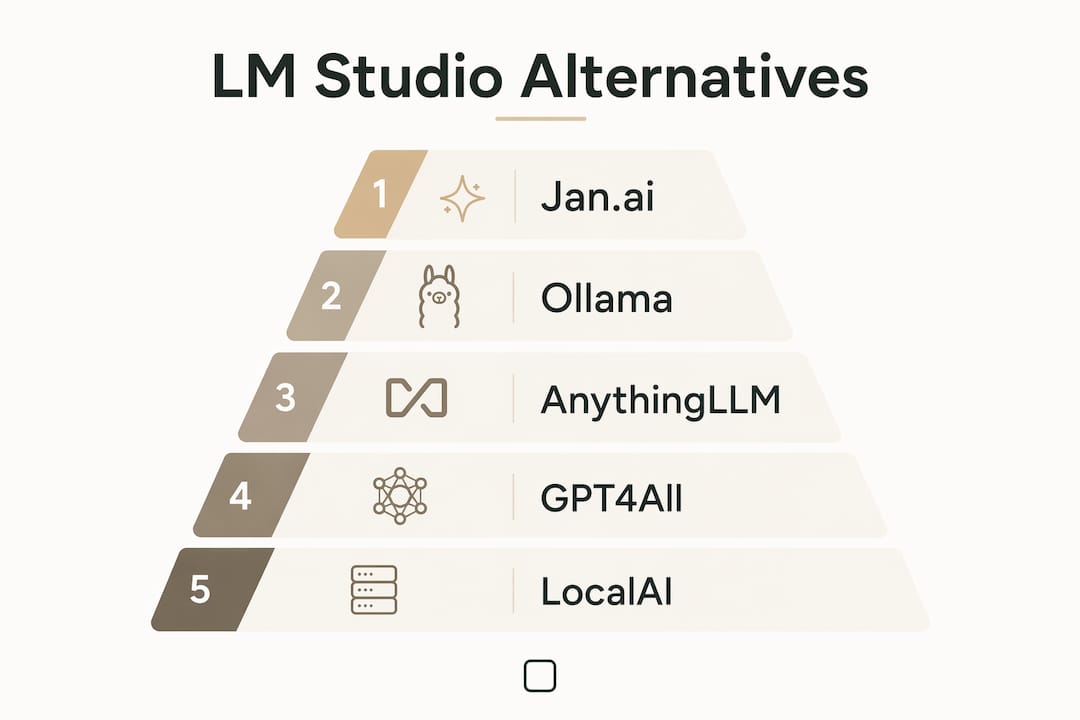
The strongest LM Studio alternatives in 2026 are Jan.ai, Ollama, AnythingLLM, GPT4All, LocalAI, Elephas, and Shinkai App. Each runs models locally, keeps your data off the cloud, and covers a different slice of the developer and power-user spectrum. If you want a single recommendation: Jan.ai is the most direct open-source replacement, matching LM Studio's GUI while adding full code auditability and faster feature adoption.
Why look past LM Studio at all? It's free but proprietary, meaning a future license change could disrupt workflows you've built around it. Open-source alternatives hand you full ownership of your local AI stack.
Quick orientation before the deep dives:
- Jan.ai: GUI-first, fully open-source, best direct swap for LM Studio users
- Ollama: CLI and API focused, broadest model support, built for developers
- AnythingLLM: Document workflows and multi-user team collaboration
- GPT4All: CPU-only capable, zero technical setup, best for non-technical users
- LocalAI: Lightweight runtime for developers building custom local apps
- Elephas: Mac-native, privacy-first productivity assistant
- Shinkai App: Offline-first design with strong data control emphasis
Hardware reality check: 8GB RAM handles small quantized models; 16GB or more opens up 7B–13B parameter models; anything above 30B needs a capable GPU alongside the RAM.
1. Jan.ai is the closest open-source replacement for LM Studio
Jan.ai sits at the top of this list for a clear reason: it replicates LM Studio's GUI experience while being fully open-source under AGPLv3. Install it, and you get a chat window, a model hub, and a settings page that doesn't require developer expertise to navigate. The interface deliberately mirrors ChatGPT's layout, so the learning curve from LM Studio is nearly flat.

What separates Jan.ai from LM Studio isn't just the license. Jan rapidly ships features that LM Studio is slow to adopt: native audio support, advanced samplers like DRY and Mirostat, and a pre-configured MCP server that connects to a Chromium browser extension with no JSON editing required. Compare that to wiring up MCP in LM Studio manually, and the gap is real.
Jan.ai also follows a file-over-app philosophy: every chat, config, and model file lives on your disk in plain formats you can open, move, or back up without touching the app. That's a meaningful difference from LM Studio's more opaque storage.
Key features at a glance:
- Fully offline operation with optional remote API support (OpenAI, Anthropic, Hugging Face Router)
- OpenAI-compatible local API server with CORS support for web projects
- Built-in model hub pulling from Hugging Face; models tagged by hardware compatibility
- Audio and image input support that LM Studio lacks
- Deep llama.cpp parameter controls exposed in the GUI
Pro Tip: When importing an existing GGUF model into Jan.ai, move it into a dedicated folder first. Jan links to files in place rather than copying them, so cleaning up the original directory later will break the model reference.
2. Ollama and AnythingLLM serve different but equally real needs
These two tools are often mentioned alongside Jan.ai, but they solve different problems entirely.
Ollama runs as a background service and exposes a local API. There's no meaningful GUI to speak of: you interact through the terminal or point other applications at its local inference server. That's not a flaw; it's the design. Ollama carries the broadest model ecosystem of any tool on this list, and it's typically the first to support new open-weight releases from Llama, Mistral, Gemma, DeepSeek, and Qwen. If you want to run a local LLM as the backend for an n8n automation, a Home Assistant voice agent, or a custom script, Ollama is the right engine. Just don't expect it to replace LM Studio as a chat app.
AnythingLLM takes a completely different angle. Its core strength is local retrieval-augmented generation over your own documents: upload PDFs, Word files, or text documents, and chat with a model about their contents. It supports multi-user workspaces with separate access controls, which makes it the only tool in this group that works for small teams rather than solo users. AnythingLLM also connects to cloud APIs alongside local models, so you can use a local LLM for sensitive document redaction and a cloud model for analysis in the same workflow.
Feature comparison:
- Ollama: terminal and API only, no GUI, fastest new-model adoption, ideal for home servers and developer pipelines
- AnythingLLM: browser-based UI, multi-user support, document ingestion, local plus cloud model blending
3. How does the interface choice affect your actual workflow?
The GUI versus CLI split is the most consequential decision when picking among these tools. It's not just about aesthetics.
GUI-first apps like Jan.ai lower the barrier for anyone who never wants to touch a terminal. Model switching, parameter tuning, and chat history are all point-and-click. The tradeoff is that GUI apps tend to start slower than CLI tools and occasionally abstract away controls you might want.

CLI-first tools like Ollama offer more power and customization, but they require comfort with the terminal and some understanding of how inference servers work. Startup times are faster, and the API-first design makes integration with other software straightforward. For developers building pipelines, that's the right trade.
Pros and cons by interface type:
- GUI apps (Jan.ai, GPT4All, Elephas): faster onboarding, visual model management, accessible to non-technical users; slower startup, occasionally less granular control
- CLI and API tools (Ollama, LocalAI): full parameter control, easy integration, faster inference startup; steeper learning curve, no built-in chat experience
- Browser-based (AnythingLLM): accessible from any device on the local network, good for teams; requires Docker or a server process running in the background
Community update frequency matters too. Jan.ai and Ollama both maintain active GitHub repositories with frequent releases. GPT4All, maintained by Nomic AI, updates regularly. Shinkai App and Elephas have smaller communities but active development.
4. Privacy and offline operation: what each tool actually gives you
Every tool on this list can run fully offline once models are downloaded. That's the baseline. The differences show up in how they handle your data at rest and whether the code is auditable.
Open-source tools (Jan.ai, Ollama, AnythingLLM, GPT4All, LocalAI) publish their full source code, meaning you can verify exactly what runs on your machine. Jan.ai's file-over-app storage keeps chat history and configs in plain text formats on your disk, with no account required and no telemetry. GPT4All similarly stores everything locally and runs without any cloud dependency. For users who want to know their data never leaves the device, open-source and auditable code is the only real guarantee.
Elephas and Shinkai App both emphasize privacy, though Elephas is Mac-only and integrates tightly with macOS document workflows. Shinkai App focuses on full offline operation with explicit data control tools built into the interface.
Privacy considerations worth checking for any tool:
- Is the source code publicly auditable?
- Does the app require an account or send telemetry by default?
- Are chat histories and model configs stored in open formats you control?
- Does the local API server expose anything outside your local network?
For a deeper look at why cloud AI raises data concerns, the question of whether ChatGPT trains on your data is worth reading before committing to any cloud-dependent workflow.
5. How to choose the right LM Studio alternative for your setup
Start with your hardware, then your workflow, then your comfort with the terminal.
Hardware first. 8GB RAM runs quantized 3B–7B models at acceptable speeds. 16GB opens up the 7B–13B range. No GPU? GPT4All is the only tool here specifically designed for CPU-only environments; everything else benefits significantly from GPU acceleration. Running models above 30B requires 32GB or more of RAM plus meaningful GPU VRAM.
Workflow second. Solo developer building integrations? Ollama. Switching from LM Studio and want minimal friction? Jan.ai. Working with documents in a small team? AnythingLLM. Mac user who wants AI woven into productivity apps? Elephas. Privacy-first offline assistant on any OS? Shinkai App or Jan.ai.
Technical comfort third. If the terminal is foreign territory, Jan.ai or GPT4All are the right starting points. If you're comfortable with APIs and want to build something, Ollama or LocalAI give you the most flexibility. For a broader look at how these tools compare to other AI tools for solopreneurs, the tradeoffs between local and cloud tools are worth examining.
Decision checklist:
- 8GB RAM, no GPU: GPT4All or a small quantized model in Jan.ai
- 16GB+ RAM with GPU: Jan.ai, Ollama, or AnythingLLM
- Need a GUI: Jan.ai or GPT4All
- Need a local API server: Ollama or LocalAI
- Team document workflows: AnythingLLM
- Mac productivity integration: Elephas
- Maximum offline privacy: Jan.ai or Shinkai App
Pro Tip: Before committing to any tool, check its GitHub release frequency. A project with commits in the last two weeks is actively maintained; one with the last release six months ago may be stalling. For local AI tools specifically, model format support (GGUF, GGML, MLX) changes fast enough that an unmaintained tool can become incompatible with new models within months.
Greencube is worth considering if you want local AI without any setup
All the tools above assume you're comfortable managing models, checking hardware compatibility, and occasionally troubleshooting a broken GGUF import. That's a fair assumption for developers. For everyone else, the setup overhead is real.
Greencube takes a different approach entirely. It's a local AI desktop app built for users who want private, offline AI without touching a model file or a config. Install it, and it works. No model selection, no quantization decisions, no subscriptions. It reads PDFs and images, runs fully offline, and costs a one-time fee rather than a monthly bill.
If you've been running Jan.ai or GPT4All and find yourself spending more time on setup than on actual work, Greencube is worth a look. It's not a developer tool; it's the option for privacy-conscious users who want the benefits of local AI without the maintenance. Get Greencube for a one-time payment and own your AI stack outright.
Key Takeaways
Jan.ai is the strongest open-source LM Studio replacement in 2026, combining a familiar GUI with full code auditability, faster feature adoption, and file-based data control.
| Point | Details |
|---|---|
| Best direct LM Studio swap | Jan.ai matches LM Studio's GUI while adding open-source transparency and features like audio support and MCP. |
| Hardware determines your options | 8GB RAM suits small models; 16GB or more is needed for 7B–13B parameter models; CPU-only users should start with GPT4All. |
| GUI vs CLI is a real tradeoff | GUI apps lower the barrier for non-technical users; CLI tools like Ollama offer more integration power for developers. |
| Teams need AnythingLLM | Solo tools like Jan.ai and Ollama lack multi-user support; AnythingLLM is the only open-source option with shared workspaces. |
| Greencube for zero-setup privacy | Greencube offers fully offline local AI with a one-time payment and no model configuration required. |