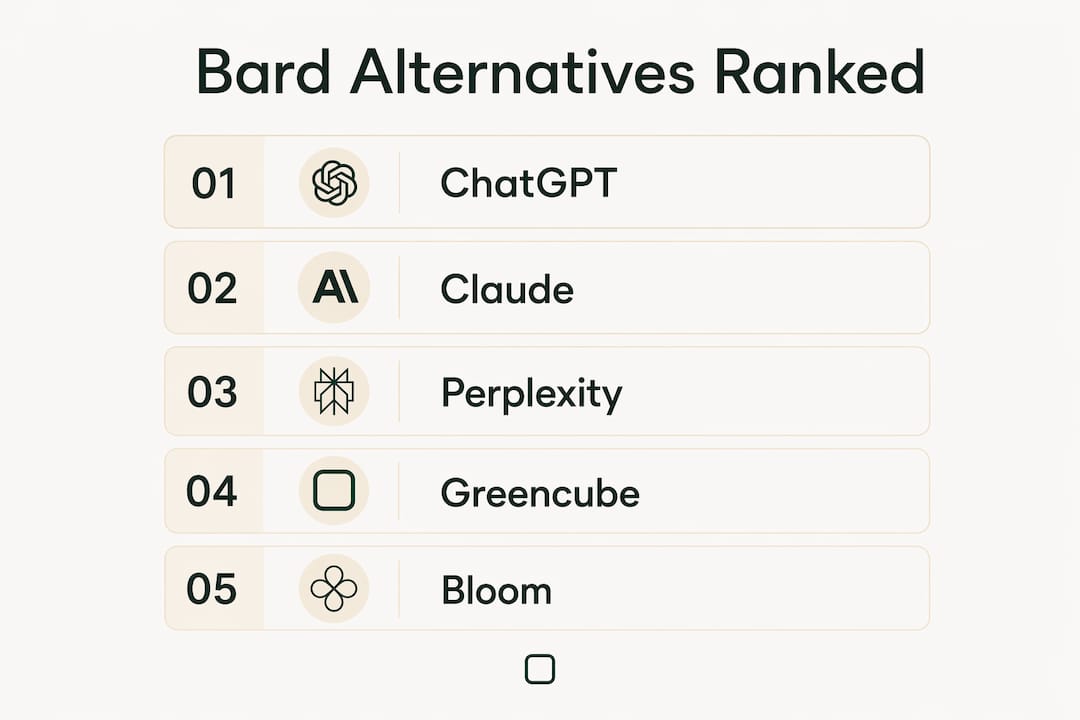
The top Google Bard alternatives are ChatGPT, Claude, Perplexity AI, and Microsoft Bing AI, each pulling ahead of Bard in a different direction. ChatGPT wins on creative output and conversational depth. Claude handles massive documents that would choke other models. Perplexity cites its sources in real time. Bing AI keeps you inside a live search loop. Here is a quick-reference breakdown before the full comparison:
- ChatGPT — strongest for creative writing, code, and sustained conversation
- Claude — 100,000-token context window, ideal for uploading full books or legal briefs
- Perplexity AI — every answer comes with source citations; free tier up to $20/month
- Microsoft Bing AI — real-time web access baked into a search engine
- OpenAI Playground — developer-grade model experimentation with broad API access
- Jasper AI / Jasper Chat — prebuilt marketing templates for copy teams
- HuggingChat — open-source models, no account required
- Copy AI — wide template library for general content
- LongShot AI — built around SEO-friendly long-form articles
- Github Copilot — context-aware code completion inside your IDE
- Greencube — fully offline, one-time purchase, nothing sent to the cloud
- Bloom, NeevaAI, YouChat, ClosersCopy, Content Villain AI, LogicBalls, Sparrow — covered below
What are the best bard alternatives and how do they compare?
Bard (now Google Gemini) was designed primarily as a search engine complement, not a general-purpose AI assistant. That core difference explains why so many users go looking for something else. The tools below cover the full range of use cases.

| Tool | Best For | Pricing | Context Window | Data Privacy | Integrations |
|---|---|---|---|---|---|
| ChatGPT | Creative writing, code, conversation | Free / $20+/mo | 100,000 tokens | Cloud; data used for training unless opted out | Zapier, Slack, plugins |
| Claude | Large document analysis, safe outputs | Free / $20/mo | Up to 100,000 tokens | Cloud; constitutional AI safeguards | Slack, Zapier, Notion, Teams |
| Microsoft Bing AI | Fact retrieval, live web queries | Free | Moderate | Cloud; Microsoft data policies | Microsoft 365, Edge |
| OpenAI Playground | Developer experimentation, fine-tuning | Pay-per-use | 100,000 tokens | Cloud | Broad API integrations |
| Jasper AI / Jasper Chat | Marketing copy, content teams | From $39/mo | Moderate | Cloud | Google Docs, Zapier, Surfer SEO |
| Perplexity AI | Research, cited answers | Free / $20/mo | Moderate | Cloud; collects user data | Slack, Discord, Notion, Zapier |
| HuggingChat | Open-source model access | Free | Varies by model | Cloud (open-source models) | Limited |
| Copy AI | General content, templates | Free / paid tiers | Moderate | Cloud | Zapier, HubSpot |
| LongShot AI | SEO blog posts, long-form | Paid tiers | Moderate | Cloud | WordPress, Semrush |
| Github Copilot | Code generation, IDE use | $10/mo | Code-context | Cloud; GitHub data policies | VS Code, JetBrains, Neovim |
| Greencube | Private offline AI, document reading | One-time purchase | Local model dependent | Fully offline, zero cloud | None (by design) |
| Bloom | Multilingual, open-source research | Free | 4,096 tokens | Self-hosted | Open-source ecosystem |
| YouChat | Conversational search | Free | Moderate | Cloud | You.com search |
| NeevaAI | Ad-free private search | Free / paid | Moderate | Privacy-focused cloud | Neeva search |
| ClosersCopy | Sales copy, marketing | Paid tiers | Moderate | Cloud | Limited |
| Content Villain AI | Quick marketing drafts | Paid tiers | Moderate | Cloud | Limited |
| LogicBalls | Task automation, productivity | Free / paid | Moderate | Cloud | Limited |
| Sparrow | Ethical AI research | Research only | — | Research context | None (experimental) |
ChatGPT is the clearest all-around performer. It generates longer, more developed creative content than Bard, stays on topic in casual conversation, and handles code, scripts, and structured writing with more nuance than either Bard or Bing AI. The free tier is usable; GPT-4 access requires a paid plan.
Claude is the go-to when you need to feed the model a full PDF, a long contract, or an entire manuscript. Its constitutional AI approach reduces harmful outputs but can make it cautious on edgy creative tasks.

Perplexity AI is genuinely different from the others: it treats every query as a research task and shows you the sources. That transparency is hard to find elsewhere, though true offline privacy still requires local hardware.
Github Copilot belongs in a separate category from the conversational tools. It lives inside your code editor and completes functions, suggests entire blocks, and catches context from the file you are working in. For developers, it is closer to a pair programmer than a chatbot.
Bloom is the open-source multilingual option for researchers who need a model they can inspect, modify, and run on their own infrastructure. It supports dozens of languages and costs nothing to access via Hugging Face.
How do pricing, ease of use, and output quality compare?
Cost and usability vary more than most comparison articles admit. Here is what actually matters when you sit down to use these tools daily.
Free tiers worth using: Perplexity AI, HuggingChat, YouChat, NeevaAI, Bloom, and the base ChatGPT tier all offer meaningful free access. HuggingChat requires no account at all for initial use.
Paid plans that justify the cost: Claude's $20/month plan unlocks the full 100,000-token context window, which is the main reason to pay. Jasper AI starts at $39/month and is aimed squarely at marketing teams who need volume output with brand voice controls. Github Copilot at $10/month pays for itself quickly if you write code regularly.
Output quality by task:
- Long-form creative writing: ChatGPT leads, followed by Claude
- Research with citations: Perplexity AI is the clear choice
- Code generation: Github Copilot for in-editor use; ChatGPT for standalone queries
- Marketing copy: Jasper AI and Copy AI both offer template-driven workflows
- Document analysis: Claude, by a wide margin, due to its context window
Context window size matters more than most users realize until they hit a limit. Uploading a 50-page report to a model with a 4,096-token cap means the model only "sees" the first few pages. Claude's 100,000-token window changes what is possible for document-heavy workflows.
Data privacy is the sharpest dividing line in this category. Every cloud-based tool collects some user data. If you are working with sensitive documents, confidential client data, or anything you would not want stored on a third-party server, a local or offline solution is the only real answer.
How to choose the right Bard alternative for your needs
The right tool depends on what you are actually doing, not on which one has the most features.
Start with your primary use case:
- Writing and creative tasks: ChatGPT or Jasper AI
- Research and fact-checking: Perplexity AI
- Large document analysis: Claude
- Code and development: Github Copilot or OpenAI Playground
- Privacy-first or offline use: Greencube
- Multilingual or open-source needs: Bloom or HuggingChat
Budget matters, but not the way you think. Free tiers are fine for casual use, but if you are running a workflow through one of these tools daily, the paid plan usually removes the friction that slows you down. Compare the monthly cost against the time you save.
Watch for ecosystem lock-in. Bing AI and Google Gemini are built to keep you inside their parent company's ecosystem, not to serve as independent assistants. That is fine if you live in Microsoft 365 or Google Workspace, but it limits portability.
Pro Tip: Before committing to any tool, create three "golden prompts" that reflect your actual recurring tasks, then run them through your top two or three candidates. Measure rework rate and factual accuracy rather than relying on feature lists. The tool that requires the least editing on your real work is the right one.
Greencube: the offline AI option worth knowing about
Every tool in this comparison runs in the cloud. That means your prompts, documents, and conversations travel to a remote server, get processed, and are stored under someone else's privacy policy. For most casual use, that is an acceptable trade-off. For sensitive work, it is not.
Greencube takes a different approach entirely:
- Fully offline: runs on your own computer, nothing sent to the cloud
- No subscription: one-time purchase, no monthly fees
- No setup required: install and use, no model configuration or technical knowledge needed
- Document and image reading: analyze PDFs and images locally
- Windows now, Mac coming: available for Windows users today
If you have ever wondered whether ChatGPT trains on your data, Greencube answers that concern structurally rather than with a privacy policy. There is no data to collect because nothing leaves your machine.
What's new in the top Bard alternatives?
The pace of updates in this space is fast. A few notable recent developments:
ChatGPT expanded its context window significantly with GPT-4 Turbo and added memory features that let it retain information across sessions. Claude has pushed its context window and improved reasoning on multi-step tasks. Perplexity AI added deeper source integration and a Pro Search mode that runs more thorough research queries. Microsoft Bing AI (now Microsoft Copilot) is embedded across Windows 11, Microsoft 365, and Edge, making it the most pervasive AI in the Microsoft ecosystem. Github Copilot added chat functionality inside VS Code, moving beyond autocomplete into full conversational coding assistance. HuggingChat expanded the roster of available open-source models, including access to newer Llama variants.
What are the real limitations of these tools?
No tool in this list is without trade-offs.
ChatGPT can hallucinate confidently, especially on niche factual questions. The free tier uses an older model. Claude is sometimes overly cautious, refusing or hedging on creative tasks that other models handle without issue. Perplexity AI is less creative than ChatGPT and charges extra for its most thorough search mode. Microsoft Bing AI is tightly coupled to Bing search, which can redirect you to web results when you wanted a direct answer. Jasper AI is expensive for solo users and its output quality depends heavily on the prompts and templates you feed it. Github Copilot is only useful if you write code; it has no value for non-developers. Bloom requires technical comfort to run and has a smaller context window than the commercial models. HuggingChat can be inconsistent across models and has introduced usage limits that may require an account. LongShot AI and ClosersCopy are narrowly focused tools that do not replace a general-purpose assistant. NeevaAI has faced questions about long-term availability. Sparrow remains a research project, not a consumer product.
The privacy limitation cuts across almost every cloud tool. Understanding how AI platforms handle your data is worth doing before you paste anything sensitive into a chat window.
Where to find support and community for each tool
ChatGPT has the largest user community of any AI tool, with active forums on Reddit (r/ChatGPT), a developer Discord, and OpenAI's own help center. Claude offers documentation through Anthropic's website and a developer API community. Perplexity AI maintains a Discord server and a public forum. HuggingChat is backed by the Hugging Face community, one of the most active open-source AI communities online, with forums, model cards, and extensive documentation. Github Copilot benefits from GitHub's existing developer ecosystem, including GitHub Discussions and extensive IDE-specific documentation. Jasper AI offers live chat support and a user community forum. Copy AI and LongShot AI both maintain help centers and user communities oriented toward content marketers. Bloom is supported through the BigScience research community and Hugging Face model hub. For AI model training data quality and workflow integration questions, the broader ML community on Hugging Face and GitHub is the most reliable resource.
Greencube: AI that's yours, not rented
Most of the tools compared here are subscriptions. You pay monthly, your data lives on their servers, and the terms can change. Greencube is a different kind of option for users who want AI without those trade-offs.
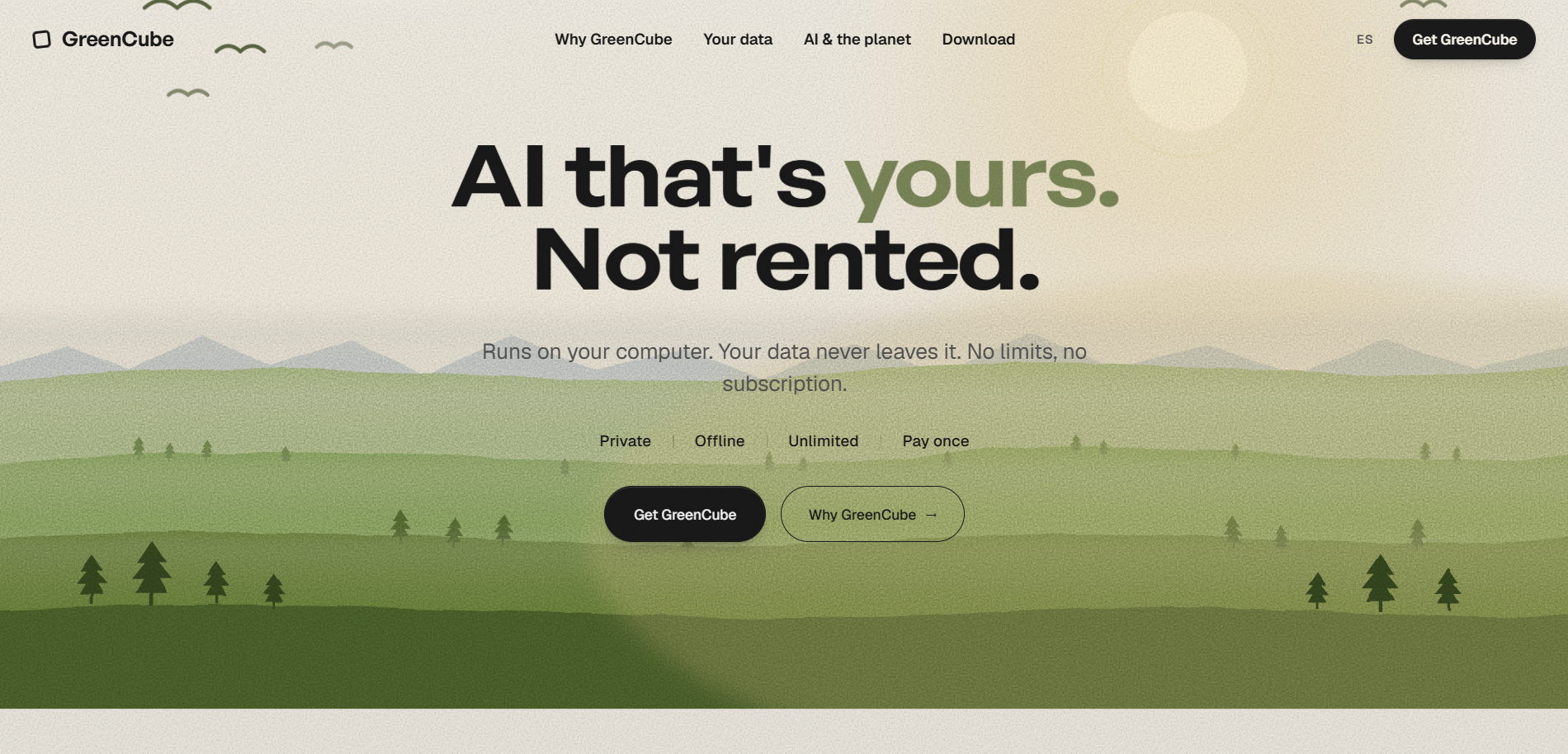
Greencube is a one-time purchase desktop app that runs entirely on your own computer. No cloud, no subscription, no account. You get private AI chat, PDF reading, and image analysis, all offline. It is built for non-technical users who want a capable AI that works the moment you install it. If the cloud-based tools in this comparison give you pause on privacy, Greencube is worth a look as a permanent, private alternative.
Key Takeaways
The strongest Bard alternative depends on your use case: ChatGPT leads on creative output, Claude on document analysis, Perplexity AI on cited research, and Greencube on offline privacy.
| Point | Details |
|---|---|
| ChatGPT leads creative tasks | Produces longer, more developed content than Bard or Bing AI across writing and code. |
| Claude's context window is unmatched | 100,000 tokens lets you upload full documents that other models cannot process. |
| Perplexity AI cites its sources | Every answer includes source links; pricing runs free to $20/month. |
| Privacy requires offline tools | Cloud platforms collect user data; true data sovereignty means running AI locally. |
| Greencube is the offline option | One-time purchase, fully offline, no subscription, works for non-technical users on Windows. |
FAQ
What is the best alternative to Google Bard?
ChatGPT is the most capable general-purpose alternative, with stronger creative output and conversational depth. For research with cited sources, Perplexity AI is the leading option.
Is ChatGPT better than Bard?
ChatGPT consistently produces more developed creative content and handles conversational tasks with more nuance than Bard, which was designed primarily as a search complement rather than a standalone AI assistant.
Which Bard alternative is best for privacy?
Greencube is the strongest choice for privacy: it runs fully offline on your own computer, with nothing sent to the cloud and no subscription required.
What is the best free Bard alternative?
Perplexity AI, HuggingChat, and the free tier of ChatGPT are all strong free options. Perplexity AI stands out because it provides source citations with every answer at no cost.
Which tool is best for analyzing large documents?
Claude handles the largest documents of any tool in this comparison, with a 100,000-token context window, making it the clear choice for long contracts, reports, or manuscripts.