What is a private AI assistant, and why does it matter in 2026?
A private AI assistant is software that runs on your own device, processes your data locally, and never sends your conversations, files, or personal details to a remote server. That last part is the whole point. Most mainstream AI tools route everything through cloud infrastructure, which means your queries, documents, and habits sit on someone else's servers, potentially used to train future models or exposed in a breach.
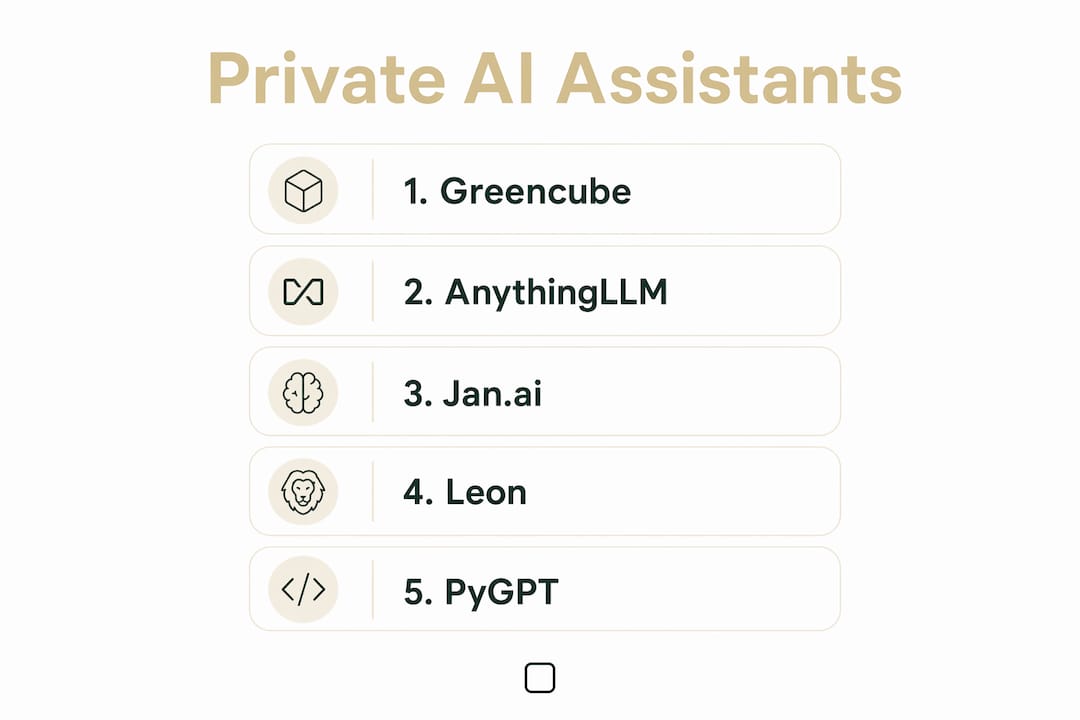
The category breaks down into two broad types. Open-source tools like AnythingLLM, Jan.ai, Leon, and PyGPT let you inspect the code, self-host the model, and own every byte of your data. Proprietary options like Greencube take a different approach: they package everything into a polished desktop app so you get full offline privacy without needing to touch a terminal. Both approaches share the same core promise: your data stays on your machine.
What separates a genuine private AI assistant from a chatbot matters more than most people realize. True AI assistants maintain persistent, long-term memory, learning your voice, projects, and preferences across sessions. A chatbot resets every time you close the window. That distinction has real privacy implications: persistent memory stored locally is yours; persistent memory stored in the cloud is a liability.
Key categories of private AI assistants available in 2026:
- Fully offline desktop apps (no internet required after installation, all processing on-device)
- Self-hosted open-source platforms (you run the server, you control the model)
- Local-first hybrid tools (default to on-device, optionally connect to cloud APIs you choose)
- Security-first agent frameworks (built for developers who need auditable, sandboxed AI workflows)
The hardware barrier that once made local AI impractical has largely collapsed. Model quantization now lets powerful AI models run efficiently on standard laptops without high-end GPUs, which means a private AI assistant is no longer a niche option for researchers with workstations. It is a practical choice for anyone with a modern laptop.
Table of Contents
- Top private AI assistants to consider in 2026
- How to choose a private AI assistant for privacy and offline use
- Privacy and security principles that define a truly private AI
- Pricing models for private AI assistants
- Greencube: a fully offline AI assistant built for non-technical users
- Key Takeaways
- Greencube is the offline AI your data has been waiting for
- FAQ
Top private AI assistants to consider in 2026
The nine tools below represent the main approaches to private, local, or security-first AI assistance available in 2026. They differ significantly in who they are built for, how much technical setup they require, and what "private" actually means in practice.
| Tool | Key features | Privacy and data control | Ease of use | Platform support | Pricing | Local/offline capability |
|---|---|---|---|---|---|---|
| Greencube | Chat, PDF reading, image analysis | Fully offline, zero cloud, no accounts | Very easy, no setup | Windows (Mac coming) | One-time purchase | Complete offline |
| AnythingLLM | Multi-model, document chat, agents | Self-hosted, local storage | Moderate | Windows, Mac, Linux | Free (open source) | Full local |
| Jan.ai | Model manager, local inference | All data on device | Easy | Windows, Mac, Linux | Free (open source) | Full local |
| Leon | Voice and text, extensible skills | Self-hosted, no cloud required | Moderate | Linux, Mac, Windows | Free (open source) | Full local |
| PyGPT | Desktop AI, plugins, vision, voice | Local storage, optional cloud | Moderate | Windows, Mac, Linux | Free (open source) | Full local |
| Vellum | Workflow builder, prompt testing | Cloud-based, enterprise controls | Easy (UI-driven) | Web | Subscription | Cloud only |
| OpenClaw | Agent orchestration, tool use | Configurable, self-hostable | Technical | Linux, Mac | Free/open source | Partial |
| QwenPaw | Qwen model integration, local chat | On-device inference | Moderate | Windows, Mac, Linux | Free (open source) | Full local |
| Hermes Agent | Hermes model, tool calling, memory | Local, no telemetry | Technical | Linux, Mac, Windows | Free (open source) | Full local |
Greencube
Greencube is the option built for people who want genuine offline privacy without any technical setup. You install it, and it works. No model downloads to manage, no accounts to create, no subscription to maintain. It handles chat, reads PDFs, and analyzes images entirely on your computer. For privacy-conscious users who are not developers, it is the most direct path to a fully private AI on your desktop. One-time purchase, Windows now, Mac coming.

AnythingLLM
AnythingLLM is one of the most capable self-hosted options available. It supports multiple local models, lets you chat with your own documents, and can run AI agents entirely on your machine. Setup requires some comfort with configuration files, but the documentation is solid and the community is active. Everything stays on your device by default, and you can point it at any locally running model you choose.
Jan.ai
Jan.ai focuses on making local model management approachable. It gives you a clean interface to download, switch between, and run open-source models without touching the command line. All inference happens on your hardware. It is a good starting point if you want to experiment with different models while keeping data local, though it lacks the document-analysis depth of AnythingLLM.

Leon
Leon is an open-source personal assistant built around a skill-based architecture, meaning you can extend it with custom modules for tasks like reminders, web search, or home automation. It runs entirely on your own server or machine. The setup is more involved than a standard desktop app, but the result is a highly customizable assistant with no cloud dependency whatsoever.
PyGPT
PyGPT is a feature-dense desktop application that supports local models, vision, voice input, plugins, and even code execution. It stores everything locally and gives you granular control over which model backends you connect to. The interface is busy by design, which suits power users who want every option visible. For someone who wants a simpler experience, it can feel like a lot.
Vellum
Vellum sits in a different category from the others. It is primarily a workflow and prompt-testing platform aimed at developers and teams building AI-powered products. It runs in the cloud, which means it does not offer local or offline operation. It earns its place on this list because some privacy-conscious teams use it for controlled, enterprise-grade AI workflows with defined access policies, not for personal offline use.
OpenClaw
OpenClaw is an agent orchestration framework designed for users who want to build multi-step AI workflows with configurable tool access. It can be self-hosted, which gives you control over data routing, but getting it running requires genuine technical comfort. Think of it as infrastructure for building your own private agent rather than a ready-to-use assistant.
QwenPaw
QwenPaw integrates Alibaba's Qwen model family into a local desktop experience. It runs inference on your own hardware and keeps conversations on-device. The Qwen models perform well on multilingual tasks, which makes QwenPaw a practical choice for users who work in languages other than English. Setup is straightforward compared to many open-source alternatives.
Hermes Agent
Hermes Agent is built around the Hermes series of fine-tuned models, which are specifically optimized for tool calling and structured reasoning. It runs locally with no telemetry and supports persistent memory stored on your machine. The setup is command-line oriented, so it is best suited to users comfortable with a terminal. The payoff is a highly capable local agent with strong function-calling performance.
How to choose a private AI assistant for privacy and offline use
The single most important question to ask before choosing any tool is: does it actually run offline, or does it just claim to? Many tools claiming privacy still rely on cloud APIs, sending your data off-device the moment you connect to a model. Check whether the tool can function with your network adapter disabled. If it cannot, it is not truly local.
Beyond that core test, here are the criteria that separate a genuinely private assistant from one that just uses the word:
- Data storage location: All conversation history, memory, and uploaded files should live on your device or your own server, not a vendor's cloud.
- Offline capability: The assistant should handle your queries without an internet connection after initial setup.
- Persistent memory control: You should be able to view, edit, and delete what the assistant remembers about you at any time.
- Export and deletion: Full data export and complete deletion from any provider systems should be straightforward, not buried in settings.
- Permission scope: The assistant should only access the files, apps, or system resources you explicitly allow.
- Update mechanism: Updates should not silently introduce cloud dependencies or change data-handling behavior without your knowledge.
The open-source versus proprietary question comes down to your priorities. Open-source tools let you audit the code and verify privacy claims independently, but they require more setup and ongoing maintenance. Proprietary tools like Greencube trade auditability for simplicity, but a well-designed proprietary tool with a clear offline architecture can be just as private in practice.
Technical requirements are more accessible than they used to be. Thanks to model quantization, a modern laptop with 8GB of RAM can run capable local models without a dedicated GPU. That said, larger models with better reasoning still benefit from 16GB or more. Before committing to a self-hosted tool, check the model's minimum hardware requirements against what you actually own.
Pro Tip: Before installing any local AI assistant, run it in a sandboxed environment or monitor its network traffic with a tool like Little Snitch (Mac) or GlassWire (Windows) for the first few sessions. A genuinely offline assistant should show zero outbound connections during normal use.
Maintaining a private assistant securely over time means treating updates with the same scrutiny you apply to the initial install. Read changelogs before updating, especially for open-source tools where a new contributor might have added a telemetry module. For proprietary tools, check whether the privacy policy has changed.
Privacy and security principles that define a truly private AI
Security-by-design is not a feature you add later. For a private AI assistant, it means the architecture assumes the worst from the start: that the model might be manipulated, that plugins might misbehave, and that the user's files are sensitive by default. Tools built this way store credentials in OS-native vaults, scope plugin permissions explicitly, and block outbound requests unless you have specifically allowed them.
The difference between a chatbot and a true AI assistant matters here too. A chatbot has no memory between sessions, which limits its usefulness but also limits its risk. An AI assistant with persistent memory that stores everything locally is more capable and, when designed well, more private than a cloud chatbot. The risk comes when that memory is stored remotely without your knowledge.
Prompt injection is the attack most people have not heard of but should understand. It happens when malicious content in a document or webpage tricks your AI assistant into taking actions you did not authorize, like exfiltrating a file or sending a message. Secure assistants mitigate this through sandboxing and permission matrices, requiring explicit human approval before any sensitive action executes. If a tool gives its AI agent unrestricted file access, that is a red flag regardless of its privacy claims.
Practical privacy principles for using any AI assistant:
- Never grant file system access broader than the specific folder you need the assistant to read.
- Treat any assistant with internet access as potentially exposed to prompt injection from web content.
- Review what the assistant has stored in memory periodically, and delete anything you did not intend to share.
- Prefer tools that publish a clear, plain-language data policy rather than a dense legal document.
- For permission-aware AI design, look for tools that log every action the assistant takes so you can audit its behavior.
User data ownership means more than just keeping data on your device. It means you can export everything in a portable format and delete it completely, with no residual copies on vendor infrastructure. That right is worth verifying before you commit to any tool, local or otherwise.
Pricing models for private AI assistants
The pricing landscape for private AI assistants in 2026 splits cleanly into three models, each with different implications for your privacy and long-term costs.
Free and open-source tools like AnythingLLM, Jan.ai, Leon, PyGPT, QwenPaw, and Hermes Agent cost nothing to download and run. Your costs are hardware (which you likely already own) and time spent on setup and maintenance. Because there is no vendor relationship, there is no subscription to cancel and no company with a financial incentive to monetize your data. The trade-off is that you are responsible for keeping the software updated and secure.
One-time purchase tools like Greencube charge a single upfront fee for a lifetime license. You pay once, own the software permanently, and never face a price increase or a forced migration to a new plan. This model aligns the vendor's incentives with yours: they want to build something good enough that you recommend it, not something that traps you in a recurring payment. For non-technical users who want offline privacy without the maintenance burden of open-source tools, this is often the most practical option.
Subscription-based tools charge monthly or annually and typically run on cloud infrastructure. Some offer strong enterprise-grade security controls, but the fundamental architecture means your data travels to their servers. For users whose primary concern is keeping data off external infrastructure, a subscription cloud tool is a structural mismatch regardless of the vendor's privacy promises.
Key cost considerations when comparing models:
- Hardware costs: Self-hosted tools may require a machine with 16GB+ RAM for larger models. Most users already own compatible hardware.
- Setup time: Open-source tools can take hours to configure correctly. That time has a real cost even if the software is free.
- Maintenance burden: Self-hosted tools need regular updates. A one-time-purchase desktop app typically handles this automatically.
- Vendor lock-in risk: Subscription tools can raise prices, change terms, or shut down. A locally installed tool you own outright cannot be taken away.
The trend toward one-time payment and self-hosted models reflects a broader shift in how privacy-conscious users think about software ownership. Renting access to an AI that learns your habits is a fundamentally different relationship than owning software that runs on your machine.
Greencube: a fully offline AI assistant built for non-technical users
Greencube occupies a specific and underserved position in the private AI space. Every other fully offline option on this list requires meaningful technical knowledge to install and maintain. Greencube does not. You download it, install it, and it works. No model selection, no configuration files, no command line.
What Greencube does on your computer:
- Chat privately: Full conversational AI, entirely on your device, with nothing transmitted externally.
- Read and analyze PDFs: Upload documents and ask questions about them without the file ever leaving your machine.
- Understand images: Describe, analyze, or extract information from images locally.
- Persistent local memory: Your conversation history stays on your computer, not on a server.
- No accounts required: There is no login, no profile, and no cloud sync to configure or worry about.
The privacy architecture is straightforward by design. Greencube has no cloud dependency. It does not phone home, does not send telemetry, and does not use your interactions to train any model. You are not the product. You are the owner.
For users who have wondered whether mainstream AI tools use their data for training, the answer is often yes by default. Greencube's privacy-first architecture sidesteps that entirely: there is no server to send data to in the first place.
The environmental angle is worth noting too. Cloud AI queries consume significant water and energy at data center scale. Running AI locally on your own hardware avoids that overhead entirely. If you want to understand the scale of that impact, the numbers on AI water consumption are more striking than most people expect.
Greencube runs on Windows today, with a Mac version in development. It is a one-time purchase, meaning you pay once and own it permanently, with no subscription and no recurring fees.
Key Takeaways
A private AI assistant that runs fully offline gives you complete data ownership, eliminates cloud exposure, and removes the risk of your conversations being used to train someone else's model.
| Point | Details |
|---|---|
| Local operation is the only true privacy | Tools that claim privacy but rely on cloud APIs still send your data off-device; test offline functionality before committing. |
| Persistent memory belongs on your device | AI assistants with local memory are more capable and more private than cloud chatbots, provided the memory never leaves your machine. |
| One-time purchase beats subscription for ownership | Lifetime-license tools like Greencube cannot be repriced, shut down, or changed without your consent the way subscription services can. |
| Open-source requires real maintenance | Free self-hosted tools like AnythingLLM and Jan.ai offer full auditability but demand ongoing setup time and security updates from you. |
| Greencube for non-technical users | Greencube delivers fully offline chat, PDF reading, and image analysis with zero setup, no accounts, and a single one-time payment. |
Greencube is the offline AI your data has been waiting for
Most of the tools in this article require you to be comfortable with terminals, config files, and model management. If that describes you, great. If it does not, those tools will frustrate you before they help you.
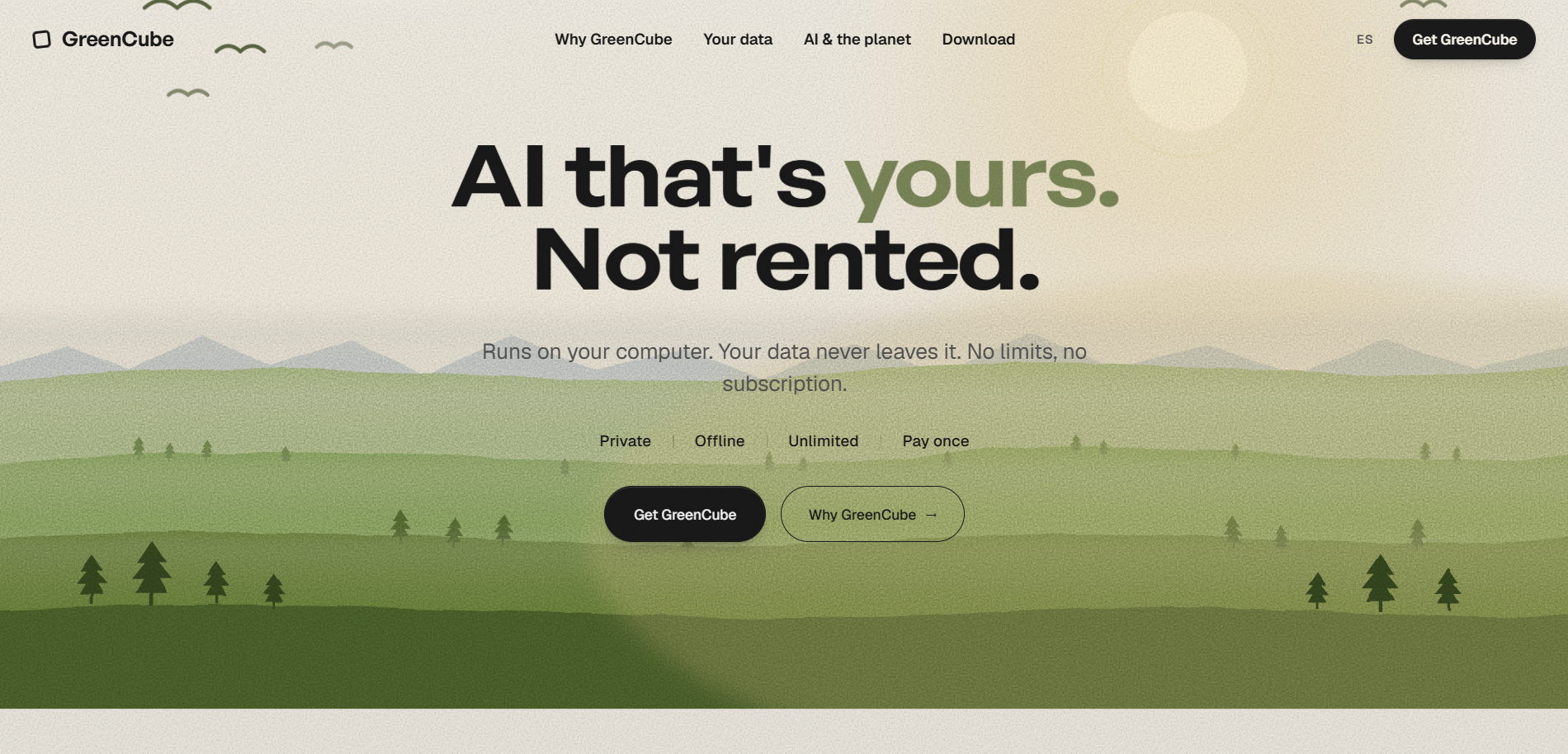
Greencube was built for the second group. It is a private AI desktop app that installs like any other Windows program and works immediately, with no accounts, no subscriptions, and no cloud connection of any kind. Chat with it, hand it a PDF, show it an image. Everything happens on your computer. Nothing leaves. For users who want the privacy benefits of local AI without the technical overhead of self-hosting, Greencube is the direct answer. It costs a single one-time payment, and it is yours permanently.
If you are ready to stop renting access to an AI that studies your habits, get Greencube and own yours outright.
FAQ
Is there an AI assistant that is completely private?
Yes. Tools like Greencube run entirely on your own device with no cloud connection, meaning your data never leaves your computer. Open-source options like AnythingLLM and Jan.ai also offer full local operation when configured correctly.
Is it possible to have an AI personal assistant that works offline?
Fully offline AI assistants are practical on modern hardware thanks to model quantization, which allows capable models to run on standard laptops without high-end GPUs. Greencube, Jan.ai, and AnythingLLM all support complete offline use.
How much does a private AI assistant cost?
Costs range from free for open-source self-hosted tools like AnythingLLM and Jan.ai to a one-time purchase for ready-to-use desktop apps like Greencube. Subscription-based AI tools typically run on cloud infrastructure, which introduces the data-privacy trade-offs that private AI assistants are designed to avoid.
Who has the best AI personal assistant for privacy?
For non-technical users who want zero setup and complete offline privacy, Greencube is the most direct option. For developers and technically confident users, AnythingLLM and Jan.ai offer full local control with open-source auditability. The best choice depends on how much configuration you are willing to manage.
What is the difference between a private AI assistant and a regular chatbot?
A private AI assistant runs locally, maintains persistent memory stored on your device, and can take actions across your files and apps. A regular chatbot resets each session and routes all data through cloud servers, giving you no control over how your conversations are stored or used.