Best AI for Students in 2026: Private, Offline, and Affordable
The best AI for students who handle sensitive coursework and don't want a subscription is GreenCube, a desktop app that runs entirely offline on your own laptop for a one-time $9.99 payment. That single fact separates it from nearly everything else on this list: no recurring fee, no document upload to a remote server, no usage caps.
The catch is honest and worth stating upfront: you download one local model (roughly 2GB or 4.2GB depending on which you pick) before it works, and you sign in once with Google or Microsoft just to verify your license. Chats and document analysis stay on your machine after that.
Two other categories cover different jobs. Cloud research assistants like Perplexity AI and Google Gemini win when you need live web reasoning and citations for a research paper. Web-based study platforms like Quizlet and RemNote win when you want built-in flashcards, spaced repetition, and account syncing across devices.
- Need private PDF or photo analysis with no subscription? Start with GreenCube.
- Need cited, up-to-date web research? Try Perplexity AI or Google Gemini.
- Need flashcards and spaced repetition synced across devices? Try Quizlet or RemNote.
The shortlist below breaks down exactly why, plus a full evaluation framework so you're not just taking our word for it.
Table of Contents
- Best AI Tools for Students: A Shortlist Worth Trying
- What Actually Determines the Right AI Tool for You?
- How Do You Choose the Right AI Study Tool?
- Getting Started With an Offline AI Study Assistant
- What Makes GreenCube a Credible Pick for Students?
- Does It Work With Your Existing Study Setup?
- What Are the Real Limits of AI Study Tools?
- The Honest Take on "Best AI for Students"
- Try GreenCube Without Signing Up for Another Subscription
- Sources
- FAQ
Best AI Tools for Students: A Shortlist Worth Trying
Here's the short version, ranked by what actually matters to a student weighing privacy, cost, and study utility, not by which name you've heard the most.
-
GreenCube costs $9.99 as a one-time purchase, tax included, with a 15-day refund window. GreenCube picks one of two local models for your PC: the smaller model (Gemma 4 E2B, about 2.6 GB) or the bigger model (Gemma 4 E4B, about 4.2GB, reads images, builds study guides, needs at least 8GB of RAM to run without slowing to a crawl on older machines). Once installed, your chats and uploaded documents, PDFs and images alike, never leave your computer. The Google or Microsoft sign-in exists solely to confirm you own the license; it does not transmit your notes or essays anywhere. It runs on Windows 10 and 11 only, with a Mac version in development. For a student concerned about uploading sensitive materials to cloud chatbots, this is the tool built with privacy in mind.
-
Cloud research assistants (Perplexity AI, Google Gemini, ChatGPT) trade privacy for reach. They query live web sources, return footnoted answers, and handle open-ended research questions GreenCube's local models can't, because those models aren't connected to the internet at all. Pricing runs free-to-limited on the base tier, then $20 or so a month for expanded access. Pick this category when your assignment needs current events, recent studies, or broad synthesis across dozens of sources, and you're not uploading anything you'd rather keep private.
-
Web-based study platforms (Quizlet, RemNote, NotebookLM) build the workflow around active recall rather than raw chat. Quizlet's spaced-repetition decks and RemNote's linked note system exist specifically to turn material into memory, not just into a summary. These run through a browser or app, sync across your phone and laptop, and mostly rely on freemium models with paid tiers unlocking AI-generated content or unlimited storage. Pick this route when the real problem is retention, not analysis.
The pattern across all three: local tools protect what you upload, cloud tools reach further into the open web, and study platforms optimize for the moment before the exam. Most students end up needing more than one.
What Actually Determines the Right AI Tool for You?
Six criteria decide fit, and most comparison articles skip past half of them.
Privacy and offline behavior matters most if you're handling graded drafts, unpublished research, or anything with a classmate's name on it. A tool that keeps processing local, the way GreenCube's chat and document analysis do, removes the question of where your data ends up entirely.
Accuracy and grounding matters for research tasks. Cloud tools with live web access, like Perplexity AI, ground answers in retrievable sources. Local models answer from what's in the conversation and any documents you've fed them, which is reliable for document Q&A but not for "what happened in the news this week."
Active learning features separate a chatbot from a study system. Flashcard generation, quizzes, and spaced repetition (the core of Quizlet and RemNote) build retention in a way a plain chat window doesn't.
Platform and OS support is the most overlooked filter. GreenCube runs Windows 10/11 only, with Mac in development, so Mac students need a browser-based option today.
Cost model splits three ways: one-time purchase, subscription, or free-with-limits. A one-time fee only pays off if you'll use the tool past the point a subscription would have cost more, which for most students is a matter of a few months.
Hardware and setup effort is the practical gatekeeper for any local tool. Model downloads run roughly 2 to 4 gigabetes, and image-capable models commonly need 8GB of RAM as a practical floor, not a comfort zone. On a laptop from 2016 with 8GB total, expect the bigger model to run slower than on a newer machine, since that RAM figure is a minimum, not a cushion.

Pro Tip: Check your laptop's RAM before picking a local AI model. Right-click the Start button, choose Task Manager, click Performance, and look at the Memory number. Under 8GB, the smaller model is your realistic option.
Weigh it like this: heavy research with citation needs points toward cloud tools; sensitive documents and offline reliability point toward local ones. Most students will want both, just for different assignments.
How Do You Choose the Right AI Study Tool?
Three steps, in order, before you install or subscribe to anything.
- List the actual tasks. Are you summarizing PDFs, drafting essays, building flashcards, or fact-checking research? Write down the top two or three, because that list eliminates most of the options on this page immediately.
- Decide your privacy and offline requirement. If any task involves ungraded drafts, personal health information, or anything you wouldn't want indexed by a third party, that requirement rules out cloud-only tools for that task, full stop.
- Compare cost against hardware. A one-time $9.99 purchase and a $20-a-month subscription land in different budget categories fast. Check your RAM against the model's stated minimum before you commit either way.
Run through these questions before you download or sign up for anything:
- Will I ever upload graded work, drafts, or anything with a professor's feedback on it?
- Do I need the tool to read images, scanned notes, or diagrams, not just typed text?
- Is my laptop at or above 8GB of RAM?
- Do I prefer paying once over paying monthly for a tool I'll use for one semester?
Pro Tip: Answer the RAM question honestly. A tool that "requires 8GB" but runs noticeably slower at exactly 8GB is telling you the truth about a minimum, not exaggerating.
Three red flags to walk away from immediately: a tool that gives confident answers with no source attribution for research tasks, a free tier that hides subscription terms until after your trial period locks in, and any "offline" claim for document reading that actually routes your file through a server first. That last one defeats the entire purpose of choosing a local tool.
Getting Started With an Offline AI Study Assistant
Here's what the first twenty minutes with GreenCube actually looks like, since setup is the one step most reviews skip.
- Download and install. Get the installer from GreenCube's site, run it, and sign in once with your Google or Microsoft account to verify the one-time license. Checkout runs through Stripe; this step confirms purchase, it doesn't upload your files anywhere.
- Pick your model. Choose the smaller model (Gemma 4 E2B, about 2.6 GB) for essay drafting and text Q&A, or the bigger model (Gemma 4 E4B, about 4.2GB, reads images, builds study guides) if you'll be uploading scanned notes or diagrams. The download happens once and takes a few minutes on a typical connection.
- Run your first real task. Import a syllabus or a reading PDF, ask it a specific question ("what are the three arguments in chapter 4?"), and generate a flashcard set from the material. This is where you'll feel the difference between a generic chatbot and a document-grounded assistant.
Pro Tip: Close background apps, browser tabs especially, before running the bigger model on an 8GB machine. Local inference competes with everything else in memory, and a dozen open Chrome tabs will cost you noticeable speed.
Remember: image reading only works with the bigger model. If you picked the smaller model for speed and then try to upload a photographed page of notes, it won't process the image, that's expected, not a bug.
What Makes GreenCube a Credible Pick for Students?
GreenCube is built on Tauri, Rust, and React, with llama.cpp handling local model inference, the same open-source engine that underpins much of the local-AI hobbyist and developer community. That stack is what makes fully offline chat and document analysis possible on ordinary consumer hardware, not a marketing claim but an architectural choice.
- One-time price: €9.99 / $9.99, tax-inclusive, with a 15-day refund window.
- Two model options at setup: the smaller model (approximately 2.6 GB, text-only) or the bigger model (about 4GB, reads images and builds study guides, needs 8GB+ RAM as a practical minimum).
- Windows 10/11 only today; Mac support is in development.
- Sign-in via Google or Microsoft verifies your license only; it doesn't transmit chat content or documents.
None of this makes GreenCube more powerful than a frontier cloud model. It isn't. Cloud systems with massive server infrastructure handle large-scale reasoning and live research better than any model that fits on a laptop.
What GreenCube sells isn't superior intelligence. It's ownership: your documents processed on hardware you control, a license you pay for once, and no monthly meter running whether you use it or not. For a student on a fixed budget handling private material, that tradeoff is the whole pitch.
The GreenCube privacy page spells out exactly what stays local and what the sign-in step actually does, which is more transparency than most AI products offer.
Does It Work With Your Existing Study Setup?
Most students don't want one AI tool, they want their existing workflow to keep working alongside whatever they add. GreenCube handles this narrowly but deliberately: it imports PDFs and, with the bigger model, images directly, so a syllabus, a scanned textbook chapter, or a photographed whiteboard becomes something you can query without routing it through a separate converter first.

It doesn't sync to Notion, Quizlet, or a learning management system, and it won't push flashcards into an existing spaced-repetition deck automatically. If your workflow already runs through RemNote for linked notes or Quizlet for daily review, GreenCube fits alongside those tools as the private analysis step, not a replacement for them. You'd use it to interrogate a dense reading before importing your own summary notes into whatever system you already trust for retention.
Cloud tools integrate more broadly by design. Notion AI writes directly inside your existing workspace, Otter.ai transcribes lectures into shareable text, and ChatPDF or PDF AI slot into browser-based reading workflows without an install step. That reach comes from being connected, the same connection that means your file touched a server somewhere before you got an answer back.
The realistic setup for most students in 2026 is layered: a cloud assistant for open research, a study platform for retention, and a local tool for anything you'd rather not upload anywhere.
What Are the Real Limits of AI Study Tools?
Every tool on this list has a ceiling, and pretending otherwise sets students up for a bad week before finals.
Local models, GreenCube's included, can't reach the open web. If your question requires knowing what happened in the news yesterday or pulling a source published last month, a local model simply doesn't have access to that, since hardware limits are the practical bottleneck for anything running fully offline.
Cloud tools carry the opposite risk: whatever you upload becomes part of a system you don't control, and free tiers often cap usage right when you need it most, mid-exam-week. AI writing detectors like Originality AI also produce false positives often enough that leaning on AI-generated first drafts without disclosure carries real academic risk regardless of which tool you used.
Humanizer tools like Clever AI Humanizer or BypassGPT promise to disguise AI text from detectors, but that's a misuse case, not a study strategy, and most institutions treat it as an academic integrity violation if discovered. None of the tools in this roundup are designed or recommended for that purpose.
And no AI tool, local or cloud, replaces the actual work of understanding material well enough to explain it without help. Flashcard generation and summarization save time; they don't substitute for retrieval practice you do yourself.
The most reliable claim about a one-time versus subscription model is a practical one, not a study-outcomes one: it fits a fixed student budget better over a semester or two.
| Point | Details |
|---|---|
| Privacy is the deciding factor for sensitive work | If you'll upload graded drafts or personal material, a local tool avoids the question entirely. |
| Hardware sets a real floor | Image-capable local models need roughly 8GB RAM as a minimum, not a comfort margin. |
| Cloud tools win at open research | Perplexity AI and Google Gemini ground answers in live web sources local models can't reach. |
| Study platforms build retention | Quizlet and RemNote turn material into memory through spaced repetition, not just chat. |
| GreenCube fits the private, budget-conscious case | A $9.99 one-time purchase with offline document analysis, the smaller or bigger model models, and Windows 10/11 support today. |
The Honest Take on "Best AI for Students"
Most roundups of student AI tools rank by feature count, then bury the privacy question in a footnote. That's backward. A student writing a thesis draft or logging a personal health project cares less about which tool has the flashiest interface and more about where that file ends up.
The conventional advice, "just use ChatGPT for everything," ignores that most students juggle at least three different needs: research, retention, and private drafting. No single tool does all three well, and pretending otherwise leads to either overpaying for a subscription bundle you half-use or uploading something you'll regret later.
Prioritize the privacy question first, before pricing, before features. Once you know what you're comfortable uploading and what you're not, the rest of the shortlist sorts itself out fast. For anything in the "not" category, a local, one-time-purchase tool earns its place on your laptop.
Try GreenCube Without Signing Up for Another Subscription
GreenCube is the alternative to another monthly AI subscription for students who are tired of recurring charges eating into a tight budget: pay $9.99 once, and it's yours, no renewal, no price hike next semester.
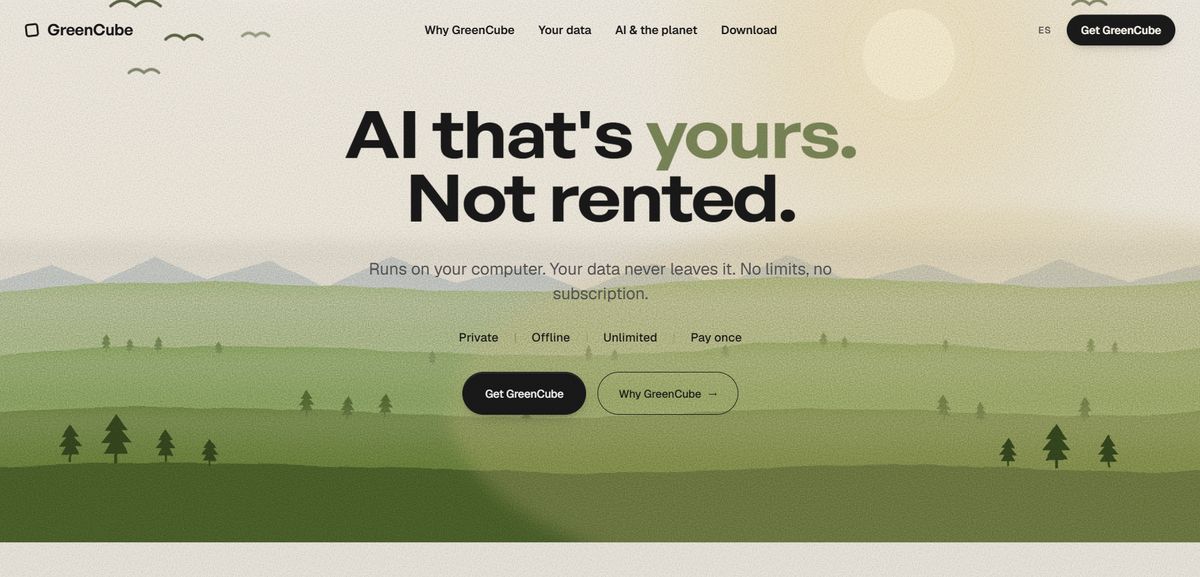
Setup takes a few minutes: download the app, sign in with Google or Microsoft to verify your license (checkout runs through Stripe), then GreenCube picks the model that fits your PC. Your documents and conversations process locally and never touch a server, a distinction worth caring about if you're analyzing drafts, case notes, or anything you wouldn't want indexed anywhere. The privacy details spell out exactly what stays on your machine.
Ready to stop paying monthly for a chatbot? Get GreenCube for $9.99 and start your first offline study session today.
Sources
- Kehn-Marv/Pinguin
FAQ
What is currently the best AI for students?
For private, offline document work with no subscription, GreenCube is the strongest pick at $9.99 one-time. For open web research with citations, Perplexity AI or Google Gemini fit better since they're built for live sourcing.
Which AI is better than ChatGPT?
"Better" depends on the task: Perplexity AI often out-cites ChatGPT for research with live sources, while GreenCube outperforms it on privacy since chats and documents never leave your device.
What AI is most used by students?
ChatGPT remains the most widely recognized general-purpose AI tool among students, though dedicated study platforms like Quizlet and RemNote see heavy daily use for exam prep specifically.
Which AI is better for college students?
It depends on the workload: cloud tools like Google Gemini suit heavy research papers, study platforms like Quizlet suit exam review, and GreenCube suits anyone handling sensitive drafts who wants a one-time cost instead of a subscription.
Does GreenCube work on Mac?
Not yet. GreenCube currently supports Windows 10 and 11 only, with Mac support in development.
Recommended
- Offline AI for Students: Study Privately on Your Laptop
- Best Private AI Assistant in 2026: Local and Offline
- AI Without Internet: Run Local AI Privately on Any Laptop
- Best Microsoft Copilot Alternatives for Privacy in 2026
Your own AI, on your own PC
GreenCube runs on your computer: no usage limits, no subscription, works without internet. €9.99, paid once.
Get GreenCube