A privacy-first offline AI desktop app gives you powerful, document-bound study tools without sending a single file to the cloud. Try Greencube first. It runs entirely on your own computer, reads your PDFs and images, and answers questions grounded only in your files. One-time purchase, no account, no subscription.
What that means in practice:
- No cloud exposure: your notes, essays, and research stay on your machine
- Document-bound answers: the AI only draws from files you add, cutting hallucination risk
- Zero recurring cost: pay once, use forever
- Works offline: no Wi-Fi needed after setup
Upload a lecture PDF and get a 200-word summary. Add a problem set and walk through solutions step by step. That's the pitch, and it works.
Table of Contents
- What can offline AI actually do for your studying?
- How does on-device AI actually work?
- What should you check before installing an offline AI?
- Will your laptop actually run it?
- How to install and start using an offline AI in minutes
- Limitations and academic integrity you need to know
- Subscription vs. one-time purchase: what actually costs less?
- Key Takeaways
- Why offline AI matters more for students than most guides admit
- Greencube is built for exactly this
- Useful sources and further reading
- FAQ
What can offline AI actually do for your studying?
The use cases are more concrete than most students expect:
- PDF summarizing: upload a chapter, ask for the five key arguments
- Document Q&A: ask "what does the author say about X?" and get an answer tied to your file
- Flashcard and quiz generation: "Create practice questions from a chapter"
- Problem walkthroughs: paste a formula or equation and ask for a step-by-step explanation
- Language practice: ask for grammar corrections or translations within your own notes
- Image reading: upload a diagram or handwritten page and ask what it shows
Two quick examples. You upload your biology lecture slides and type: "Summarize this in 5 bullet points." The app reads only those slides and returns a tight summary. No browsing the web, no pulling in outside sources. Second example: you paste a calculus problem and ask, "Walk me through this step by step." The model reasons through it locally, on your CPU or GPU, with no round-trip to a server.
Pro Tip: Binding AI answers strictly to your own files, a technique called source isolation, dramatically reduces hallucinations. The model can't invent facts it has no access to.

Because these apps run models locally after a one-time setup, there are no ongoing API or subscription fees eating into your budget each month.
How does on-device AI actually work?
Edge AI runs model inference directly on your machine using locally stored model files and embeddings. No request leaves your laptop.
Here's the plain-language version of what happens under the hood:
- Model files are downloaded once and stored on your drive. Think of them as the AI's brain, frozen at a point in time.
- Embeddings convert your documents into a format the model can search quickly. These live in a local vector store.
- Document ingestion is when you add a PDF: the app reads it, creates embeddings, and indexes it locally.
- Local inference is the actual question-answering step. Your CPU or GPU runs the computation; nothing touches the internet.
Offline versus cloud, side by side:
| Factor | Offline/local | Cloud-based |
|---|---|---|
| Privacy | Files stay on device | Files sent to vendor servers |
| Latency | Low (no network hop) | Depends on connection |
| Cost | One-time or free | Ongoing subscription |
| Model freshness | Fixed until you update | Continuously updated |
| Hardware need | Your CPU/GPU | Vendor's servers |
Some apps squeeze better performance out of specific hardware through techniques like model quantization and pruning, which shrink model size without gutting accuracy. Arm-optimized builds, for instance, deliver noticeably better battery life on supported devices.
What should you check before installing an offline AI?
Run through this list before you download anything:
- Privacy guarantee: does the vendor publish a clear data-handling policy? Read it.
- Truly offline or hybrid? Some apps default to local models but allow cloud fallback. Verify whether "offline" means no cloud, ever.
- Document binding: does the AI answer only from your files, or does it mix in general web knowledge?
- Supported file types: PDF is the minimum. Image support (JPG, PNG) is a bonus for diagram-heavy courses.
- Automatic model management: can a non-technical user install it without touching config files or setting up a vector database manually?
- Ease of install: a setup wizard beats a command-line tutorial for most students.
- Hardware requirements: check RAM, disk space, and GPU VRAM before downloading.
- No account required: the best offline apps need no login, no API key.
- One-time payment option: subscriptions add up; a lifetime license is cheaper over a degree.
- Published privacy docs: a transparency page signals the vendor takes this seriously.
How Greencube maps to each point: fully on-device processing with no cloud fallback, document-bound answers, PDF and image support, automated model management behind a clean installer, no account or API key required, one-time purchase, and a published privacy transparency page.
When is a hybrid mode acceptable? If you need to analyze very large documents that exceed your laptop's RAM, a hybrid app that lets you opt into cloud processing for that one task is a reasonable trade-off. Just know what you're trading.
Will your laptop actually run it?
| Spec | Minimum | Recommended |
|---|---|---|
| CPU | Modern quad-core | 8-core |
| RAM | 8 GB | 16 GB |
| GPU VRAM | Integrated (slow) | 6 GB+ discrete |
| Free disk space | 10 GB | 20 GB+ |
| OS | Windows 10 | Windows |
On integrated graphics, smaller models (3B–7B parameters) run fine for text tasks but feel sluggish on longer documents. A discrete GPU with 6 GB+ VRAM makes a real difference for speed and comfort.
Pro Tip: Store model files on an SSD, not an HDD. The speed difference at load time is significant. Reserve at least 10 GB free for models, embeddings, and cache.
The initial model download often runs several gigabytes. You need a working internet connection for that first pull, then you're offline for good. Plan for it on a fast connection, not your phone's hotspot.
How to install and start using an offline AI in minutes
- Download the installer from the vendor's website (Greencube: greencube.app).
- Run the setup wizard. Accept defaults unless you have a specific model preference.
- Choose local model mode when prompted.
- Add your first document: drag a PDF into the app or use the "Add files" button.
- Open the chat and type your first prompt.
Sample prompts to try right away:
- "Summarize this lecture in 5 bullet points."
- "Create practice questions from a chapter."
- "Explain this formula step by step."
- "What are the three main arguments in this paper?"
Common first-run issues:
- Insufficient disk space: free up at least 10 GB before installing.
- Model download fails: check your connection; pause other downloads.
- No GPU acceleration detected: the app will fall back to CPU. Slower, but it works.
- App permissions blocked: on Windows, allow the app through your firewall when prompted.
Model updates are manual in most offline apps. A brief internet connection is needed when you choose to pull a newer model version. Otherwise, the app runs entirely offline.
Limitations and academic integrity you need to know
Offline models can and do hallucinate. They may state a plausible-sounding fact that isn't in your document. Always verify any specific claim against the original source before citing it.
Key limitations to keep in mind:
- Models are frozen at their training cutoff. They won't know about papers published last month.
- Hardware constraints cap model size, which affects reasoning depth on complex problems.
- Local apps store your data on-device, but your laptop itself must be secured.
Academic integrity best practices:
- Use offline AI for studying, drafting, and understanding. Not for submitting.
- Check your school's AI policy before using any AI tool on graded work.
- Never submit AI-generated text as your own writing without disclosure.
- Verify every citation the AI suggests against the actual source document.
Security basics: lock your laptop with a strong password, encrypt sensitive files using BitLocker (Windows) or FileVault (Mac), and review what permissions the app requests during install.
Subscription vs. one-time purchase: what actually costs less?
- Subscription apps: lower upfront cost, but $10–$20/month adds up to $120–$240/year. Cloud compute, always-updated models, but your data leaves your device.
- One-time purchase apps: higher day-one cost, then nothing. Offline, private, predictable. Greencube's one-time license is the clearest example of this model for students.
- Free open-source options: tools like locally hosted open-weight models are free but require technical setup. Expect to configure Ollama, ChromaDB, or similar tools manually. Not ideal if you're not a developer.
Hidden hardware costs are real. If your laptop needs a GPU upgrade to run larger models comfortably, factor that in. For most students, a well-optimized desktop app on existing hardware beats a DIY setup that demands hours of configuration. EdTech product analysts note that offline feature selection matters as much as the underlying model when choosing a study tool.
Key Takeaways
Offline AI for students is practical today: install once, add your documents, and get private, document-bound answers with no subscription and no data leaving your laptop.
| Point | Details |
|---|---|
| Privacy is the core advantage | On-device processing means your notes and files never reach a vendor's server. |
| Check hardware before installing | Aim for sufficient RAM and GPU VRAM for smooth performance; adequate free disk space is recommended. |
| Document binding cuts hallucinations | AI answers grounded only in your files are more accurate for your specific coursework. |
| One-time purchase saves money | A lifetime license costs less than a year of most cloud subscriptions. |
| Greencube is the recommended starting point | No account, no API key, one-time purchase, fully offline with PDF and image support. |
Why offline AI matters more for students than most guides admit
The standard argument for offline AI is privacy. That's real, but it undersells the actual benefit. Edge AI reliability means your study session doesn't break when the campus Wi-Fi goes down, when a vendor has an outage, or when you're on a train with no signal. Data sovereignty means your research notes, your draft thesis, your personal study materials belong to you. Not to a company whose terms of service you scrolled past. Students are in a particularly vulnerable position here: you're generating genuinely sensitive intellectual work, often under institutional rules about data handling. An offline-first tool removes that exposure entirely. As model optimization continues improving, offline desktop apps will only get faster and more capable on the same hardware you already own.
Greencube is built for exactly this
Most students don't want to configure a local AI stack. They want to open an app, drop in a PDF, and ask questions. Greencube is built for that. It runs fully on your computer, reads your PDFs and images, and answers only from your files. No account. No API key. No subscription. One payment, and it's yours.
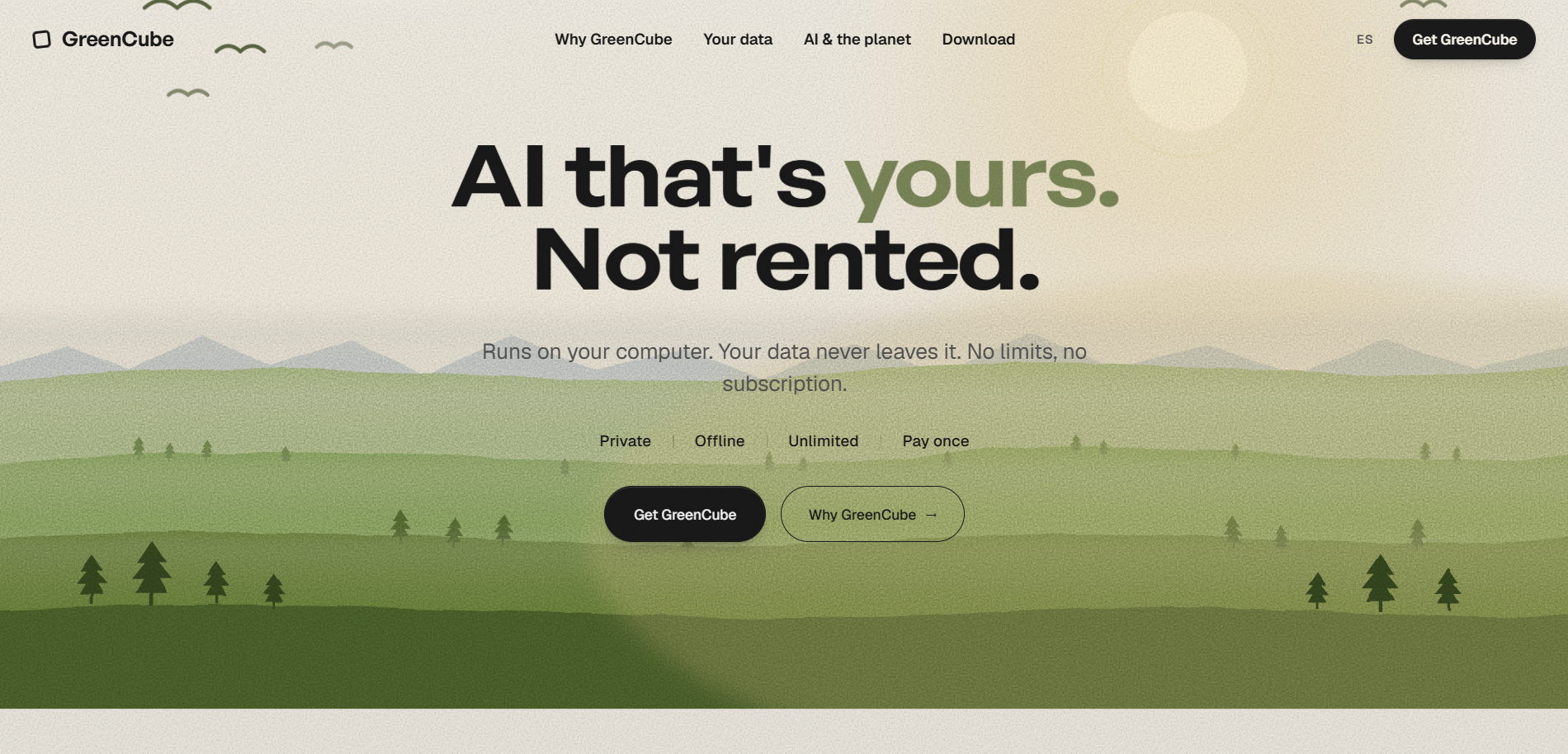
The privacy transparency is published openly, so you can read exactly how your data is handled before you spend a dollar. For students who want a capable, private AI study tool without the technical overhead, Greencube is the shortest path from "I want this" to "it works." Get Greencube and run the quick setup from the install section above. You'll have a working document-bound AI on your laptop in under ten minutes.
Useful sources and further reading
- Greencube product page: core product claims, privacy-first positioning, and download instructions.
- Greencube purchase page: one-time license details.
- Does ChatGPT train on your data?: Greencube's transparency article on how cloud AI handles user data. Read before choosing any cloud tool.
- Milvus Edge AI primer: clear technical explanation of how on-device inference works and why it enables offline operation.
- AI-Study-Buddy (GitHub): open-source reference for browser-based offline AI study tools; useful for understanding the no-subscription local model approach.
- Pinguin (GitHub): architecture-optimized offline study app; good reference for Arm64 performance and local vector store design.
Before installing any offline AI app, check the vendor's privacy page and system requirements page first. Those two pages tell you everything you need to know about whether the app is genuinely private and whether your hardware can run it.
FAQ
Does offline AI for students actually work without internet?
Yes. After the initial model download, apps like Greencube run entirely on your device with no internet connection required. All processing happens locally on your CPU or GPU.
Will offline AI work on my student laptop?
Most modern laptops with 8 GB RAM can run smaller local models. For comfortable performance, 16 GB RAM and a discrete GPU with 6 GB+ VRAM are recommended, though integrated graphics will work at reduced speed.
Is using offline AI cheating?
That depends on your school's policy. Using AI to study, understand material, and draft ideas is generally acceptable; submitting AI-generated work as your own is not. Always check your institution's academic integrity guidelines.
What makes Greencube different from cloud AI study tools?
Greencube processes everything on your own computer. No files are sent to external servers, there's no account required, and you pay once for lifetime access rather than a monthly subscription.
How much disk space do I need for an offline AI app?
Plan for at least 10 GB free before installing, which is enough to accommodate model files, document embeddings, and cache. Store everything on an SSD for the best load times.