
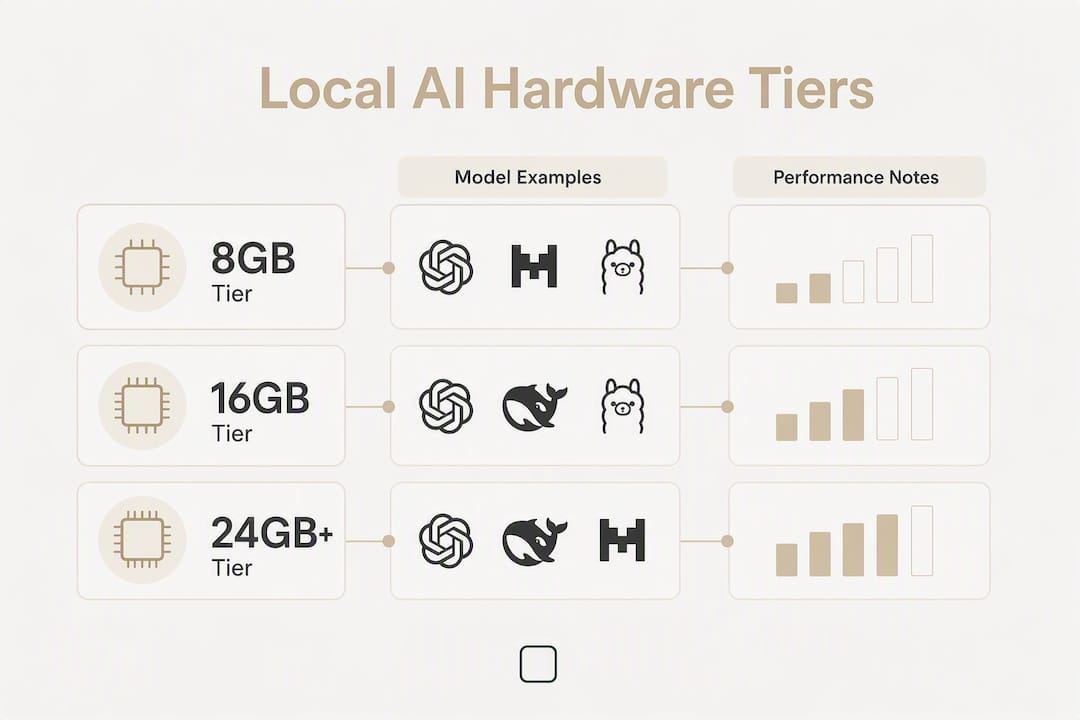
For 8GB systems, quantized 7–8B models like Gemma 4 E4B and Phi-4-mini are your best options. At 16GB, models like Qwen 3.6 and Mistral Small provide improved quality while fitting within memory constraints. 24/32GB GPUs enable running well-quantized models in the 20-35 billion parameter range, such as DeepSeek R1 distilled and Llama 4 Scout. 48GB and above configurations support larger and more complex models including Kimi K2, Llama 4 Maverick, and full Qwen 3.5 MoE variants with sufficient memory headroom.
| Tier | Recommended Family | Quantized Footprint | Best For |
|---|---|---|---|
| 8 GB | Gemma 4 E4B, Phi-4-mini | 3–5 GB (Q4_K_M) | General chat, light coding |
| 16 GB | Qwen 3.6, Mistral Small | 8–12 GB (Q4_K_M) | Coding, reasoning, RAG |
| 24/32 GB | DeepSeek R1 Distilled, Llama 4 Scout | 16–20 GB (Q4_K_M) | Coding agents, long context |
| 48 GB+ | Kimi K2, Llama 4 Maverick, Qwen 3.5 MoE | 40–45 GB (Q4_K_M) | Agentic workflows, multimodal |
Quick picks:
- 8 GB: Phi-4-mini fits in 4 GB; Gemma 4 E4B handles images too.
- 16 GB: Qwen 3.6 14B at Q4_K_M is the strongest all-rounder at this tier.
- 24/32 GB: DeepSeek R1 Distilled 32B gives you frontier-class reasoning on a single card.
- 48 GB+: Kimi K2 and Llama 4 Maverick are the ceiling of what a single workstation can handle.
Table of Contents
- What "runs locally" actually means for your hardware
- Which models fit your hardware tier?
- Per-model profiles: specs, license, and inference notes
- How to get these models running on your machine
- How these recommendations were chosen
- Key Takeaways
- Why local models are now a professional default, not a hobbyist project
- Greencube: private offline AI without the setup overhead
- Useful sources
- FAQ
What "runs locally" actually means for your hardware
Memory is the hard constraint, and it is less forgiving than most guides admit. Every token the model generates requires the full weight set to be resident in memory. Run out, and the model either refuses to load or crawls through swap at 1–2 tokens per second, which is unusable for interactive work.

Unified memory vs. discrete VRAM. On Apple Silicon (M2, M3, M4 series), RAM and GPU memory share the same pool. A MacBook Pro with 24 GB of unified memory can load a model that would require a discrete 24 GB GPU on a Windows machine. On NVIDIA and AMD cards, only the VRAM on the card counts; system RAM can absorb overflow through CPU offloading, but at a steep speed penalty.
Practical memory floors by use case:
- Interactive chat (sub-5-second response): 8 GB minimum, 16 GB comfortable
- Coding agent with multi-file context: 16 GB minimum, 24 GB recommended
- Long-context document Q&A (32K+ tokens): 24 GB minimum; 32 GB gives real headroom
- Agentic workflows with tool calls: 48 GB+ for reliable throughput
Storage and disk speed matter more than people expect. A 20B model at Q4_K_M produces a GGUF file around 12–14 GB. Loading that from a spinning hard drive takes 60–90 seconds; an NVMe SSD cuts it to under 10 seconds. For models you use daily, keep them on NVMe. For archival or occasional use, a fast SATA SSD is acceptable.
Quantization's effect on footprint. Quantization reduces memory use by roughly 50–70% with small quality trade-offs for most workloads. A 32B model in BF16 needs roughly 64 GB; the same model at Q4_K_M fits in about 18–20 GB. Q4_K_M is the default to start with. Q8_0 is noticeably sharper on reasoning tasks but nearly doubles the footprint. BF16 is only practical at 48 GB+ for 20B-class models.
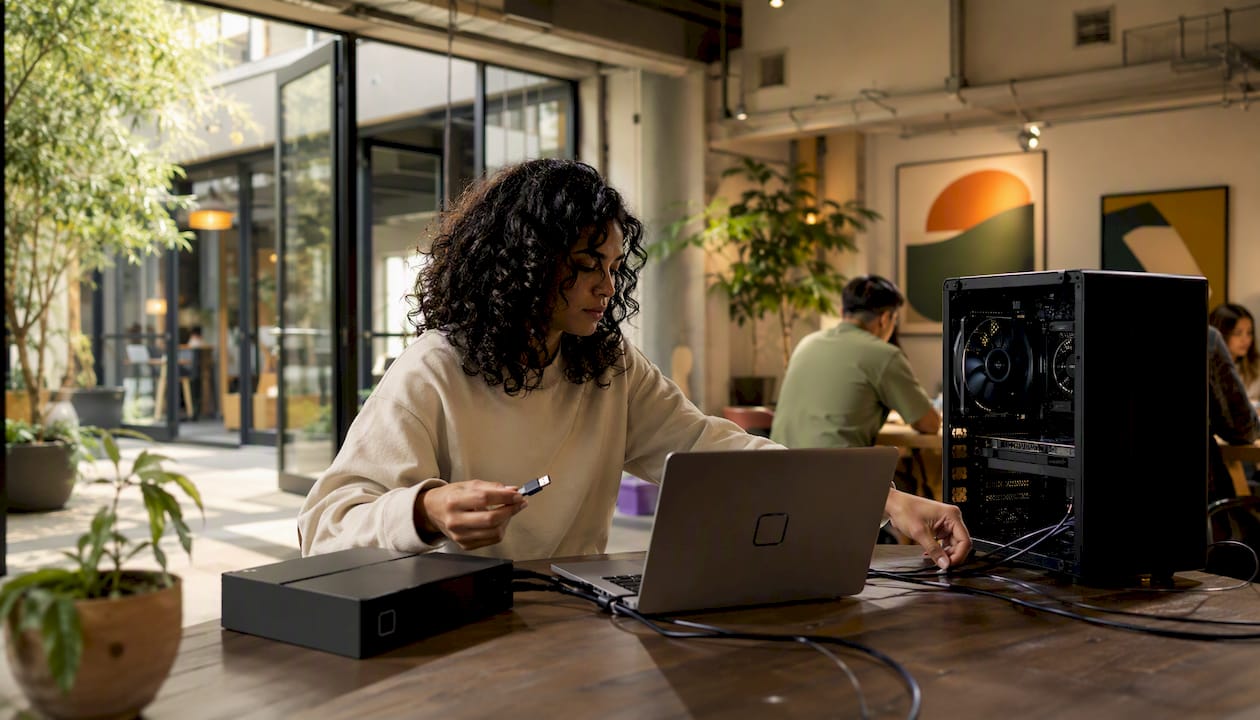
CPU-only inference is viable for small models (7–8B at Q4_K_M) if you have a fast modern processor and 16+ GB of RAM, but expect 3–8 tokens per second rather than 30–60 on a mid-range GPU. For anything above 13B parameters, a GPU is worth the investment.
Pro Tip: On Linux or macOS, run nvidia-smi --query-gpu=memory.free,memory.total --format=csv (NVIDIA) or system_profiler SPDisplaysDataType | grep VRAM (Mac) to see exactly how much GPU memory is free before loading a model. On Windows, open Task Manager → Performance → GPU to read dedicated and shared memory live.
| Hardware | Practical Model Ceiling | Notes |
|---|---|---|
| 8 GB VRAM / RAM | 7–8B at Q4_K_M | CPU offload possible but slow |
| 16 GB VRAM / unified | 13–14B at Q4_K_M | Sweet spot for most laptops |
| 24 GB VRAM | 32B at Q4_K_M | Single-card serious inference floor |
| 48 GB+ (dual 24 GB or workstation) | 70B+ at Q4_K_M or MoE 100B+ | Full agentic and multimodal range |
Which models fit your hardware tier?
8 GB tier: small but capable
Gemma 4 E4B and Phi-4-mini are the two models worth loading first. Phi-4-mini fits in 4 GB and punches well above its size on reasoning and structured output. Gemma 4 E4B adds multimodal support, so you can drop an image into the prompt alongside text. Neither will win a coding benchmark against a 30B model, but both are genuinely useful for daily chat, summarization, and light scripting tasks.
- Gemma 4 E4B: multimodal, ~3–4 GB at Q4_K_M, good for image + text tasks
- Phi-4-mini: ~3 GB, best-in-class reasoning for its size, coding and math
- Qwen 3.6 7B (if available as GGUF): strong multilingual support, fits at ~5 GB
16 GB tier: where local AI gets genuinely useful
This is the tier where the quality gap between local and cloud starts to close for everyday tasks. Qwen 3.6 14B at Q4_K_M is the strongest all-rounder here: solid coding, good instruction following, and a 128K context window that makes document Q&A practical. Mistral Small (the 22B variant at aggressive quantization, or the 12B variant at Q4_K_M) is a close second, with particularly clean output for structured tasks like JSON extraction and function calling.
- Qwen 3.6 14B: ~9–10 GB at Q4_K_M, 128K context, best general-purpose pick
- Mistral Small 12B: ~8 GB at Q4_K_M, fast inference, strong at structured output
- Gemma 4 12B: ~8 GB at Q4_K_M, multimodal, good for document + image workflows
- DeepSeek R1 Distilled 14B: ~9 GB at Q4_K_M, best reasoning at this tier
24/32 GB tier: serious single-GPU inference
A 24 GB GPU is the practical single-card floor for running 20B–35B-class models in 2026. At this tier, the model quality is close enough to GPT-4-class outputs for most professional tasks.
- DeepSeek R1 Distilled 32B: ~18–20 GB at Q4_K_M, best reasoning model at this tier
- Llama 4 Scout: ~16–18 GB at Q4_K_M, strong coding and long-context performance
- Qwen 3.6 32B: ~20 GB at Q4_K_M, excellent all-rounder with 128K context
- Mistral Medium: ~18 GB at Q4_K_M, clean structured output, good for RAG pipelines
For long-context document workflows (legal, research, technical), Qwen 3.6 32B's 128K context window is the practical choice. For pure reasoning and math, DeepSeek R1 Distilled 32B is the pick.
48 GB+ tier: workstation and dual-GPU setups
- Kimi K2: MoE architecture, strong agentic and tool-use performance, fits at ~40–45 GB
- Llama 4 Maverick: dense architecture, strong multimodal, ~35–40 GB at Q4_K_M
- Qwen 3.5 MoE full: large MoE, best multilingual and coding at this tier
- DeepSeek R1 full 70B: ~40 GB at Q4_K_M, top reasoning if you have the VRAM
Per-model profiles: specs, license, and inference notes
Gemma 4 (Google DeepMind)
Gemma 4 ships in compact edge variants (E2B, E4B) designed for low-memory devices and larger MoE variants (26B+) for high-end hardware. The E4B is multimodal and fits in 3–4 GB at Q4_K_M, which makes it the most accessible capable model for 8 GB machines. The 26B MoE variant needs 24 GB+ and delivers noticeably better reasoning. License: Apache 2.0 for most variants (check the specific model card for commercial use terms). Available on Hugging Face and as GGUF builds.
Qwen 3.5 / Qwen 3.6 (Alibaba Cloud)
Qwen 3.6 is the practical workhorse of the 16–32 GB tier. The 14B and 32B variants both support 128K context natively, which is a real advantage for RAG and document-heavy workflows. Qwen 3.5 MoE is the full-scale variant for 48 GB+ setups. License: Qwen models use a custom license that permits commercial use for most organizations; verify the specific version's license card before production deployment. Strong multilingual support across 100+ languages.
DeepSeek R1 / R1 Distilled (DeepSeek AI)
DeepSeek R1 is the reasoning specialist of the local model ecosystem. The distilled variants (7B, 14B, 32B) bring R1-class chain-of-thought reasoning into smaller packages that fit on consumer hardware. The 32B distilled version at Q4_K_M is the best single-card reasoning model available in 2026 for most professionals. License: MIT for the distilled variants, which means commercial use is permitted. The full R1 70B requires 48 GB+ at Q4_K_M.
MoE note: DeepSeek R1's full architecture uses a Mixture-of-Experts design. Although only a fraction of experts activate per token, the full MoE weight set must be resident in VRAM. Total parameter count drives memory planning, not active parameter count. A model advertised as "671B total, 37B active" still needs VRAM proportional to 671B weights at your chosen quantization.
Mistral Small / Mistral Medium (Mistral AI)
Mistral Small (12B–22B range depending on version) is the fastest model at the 16 GB tier for structured tasks: JSON extraction, function calling, and classification. Mistral Medium (around 22–30B) steps up quality for general reasoning and fits at 24 GB with Q4_K_M. Both models are available as GGUF builds. License: Mistral models use a custom Apache-style license; commercial use is generally permitted but check the specific release. Mistral's inference speed is consistently among the highest tokens-per-second for its parameter class.
Phi-4 / Phi-4-mini (Microsoft)
Phi-4-mini is the standout model for 4–8 GB machines. Microsoft's training approach emphasizes reasoning quality per parameter, and it shows: Phi-4-mini outperforms many 7B models on math and structured reasoning benchmarks despite its smaller footprint. Phi-4 (the full version, ~14B) fits comfortably at 16 GB and is a strong coding and reasoning model. License: MIT, fully open for commercial use. Available on Hugging Face with GGUF builds widely maintained by the community.
Llama 4 Scout / Maverick (Meta)
Llama 4 Scout is Meta's efficient variant, targeting the 16–24 GB tier with strong coding and long-context performance. Maverick is the larger multimodal variant for 48 GB+ setups. Both support multimodal inputs (text + image). License: Meta's Llama 4 license permits commercial use for most organizations (under 700M monthly active users); read the license if you are deploying at scale. GGUF builds are available through the community on Hugging Face.
Kimi K2 (Moonshot AI)
Kimi K2 is the newest entry on this list and the most capable model for agentic workflows at the 48 GB+ tier. Its MoE architecture means the active parameter count per token is much lower than the total, but the full weight set still needs to be in memory. Kimi K2 scores at the top of community self-hosted leaderboards for tool use and multi-step reasoning. License: check the Kimi K2 model card directly; commercial terms were still being clarified at the time of writing.
Quantization savings in practice: a 32B model in BF16 requires roughly 64 GB of VRAM. The same model at Q4_K_M fits in 18–20 GB, a reduction of roughly 68–70%. Q4_K_M is the recommended default for single-card setups.
How to get these models running on your machine
The local model ecosystem has three layers: the model file (GGUF format for most consumer setups), the inference engine that loads and runs it, and the frontend that gives you a chat interface or API endpoint.
Step 1: Get the model file
Download GGUF-format model files from Hugging Face. Search for the model name plus "GGUF" and look for community-maintained quantized builds (Bartowski and TheBloke are the most prolific maintainers). Pick the Q4_K_M file for your first run; it is the best balance of quality and footprint.
Step 2: Choose a runtime
Three categories cover most setups:
- Lightweight C runtimes (llama.cpp and its derivatives): fastest raw inference, command-line focused, best for scripting and API use. Works on NVIDIA (CUDA), AMD (ROCm), Apple Silicon (Metal), and CPU-only.
- GUI model browsers: desktop apps that wrap llama.cpp with a chat interface, model library, and one-click downloads. Local frontends are adding agentic features and tighter OS integration as the next evolution; the practical difference between them is UI and workflow integrations rather than raw inference speed.
- Python SDKs (Hugging Face Transformers, vLLM): best for developers building pipelines; more setup required but more flexible for fine-tuning, batching, and custom inference logic.
Step 3: Load and run
For a lightweight C runtime (example flow):
- Download the GGUF file to a local directory.
- Install the runtime (follow the project's README; most offer pre-built binaries for Windows, macOS, and Linux).
- Run with a context size flag:
--ctx-size 4096for general chat,--ctx-size 16384for document Q&A. - Add
--n-gpu-layers 99to offload all layers to GPU; reduce this number if you hit out-of-memory errors.
For Apple Silicon (M-series):
Mac-optimized frameworks run natively on M-series chips using Metal acceleration. Most GUI frontends support Metal out of the box; no separate CUDA setup is needed.
Common flags to reduce memory:
--n-gpu-layers [N]: reduce N to offload fewer layers to GPU and more to CPU/RAM--ctx-size [N]: smaller context uses less KV cache memory; 2048 is the minimum for useful chat--mlock: prevents the model from being swapped to disk mid-session (Linux/macOS)
Pro Tip: If you hit out-of-memory errors, try reducing --n-gpu-layers by 10 at a time until the model loads. Each layer you move to CPU costs roughly 2–5 tokens/sec in throughput. For a 32B model on a 24 GB card, leaving 2–4 layers on CPU is often the difference between loading and crashing.
Troubleshooting quick reference:
- Out of memory on load: reduce
--n-gpu-layersor switch to a smaller quantization (Q4_K_M → Q3_K_M) - Slow tokens (under 3/sec): too many layers on CPU; add more GPU layers or use a smaller model
- Model not found: verify the GGUF file path is absolute, not relative
- Garbled output: wrong chat template; check the model card for the correct prompt format
How these recommendations were chosen
The selection criteria follow four filters, in priority order:
- Fit: does the model load under its quantized footprint on the stated hardware tier, with at least 2 GB of headroom for KV cache?
- License permissiveness: is commercial use permitted without restrictive terms for most professionals?
- Real-world task strength: does the model perform well on the tasks the tier's users actually run (coding, reasoning, RAG, multimodal)?
- Benchmark evidence: are the claims backed by published single-card tests or community leaderboard data?
Benchmarks referenced: The Onyx self-hosted LLM leaderboard covers quality, speed, and hardware requirements for enterprise self-hosted deployments. Community roundups from Pinggy and Mayhemcode provide single-card test data across Ollama and LM Studio runtimes. For speed, tokens per second at interactive latency (above 10 tok/sec) is the threshold; below that, the model is too slow for real work.
The 24 GB floor: 24 GB is the practical single-GPU floor for serious local inference in 2026. Below that, you are working with models that are capable but limited; above it, you get frontier-adjacent quality on a single card.
Recency requirement: only 2026 model versions were considered for primary recommendations. Model families that have not released a 2026 update were excluded from the top picks, since the improvement rate in this space means a 12-month-old model is often two capability generations behind.
Update cadence varies significantly across families. Qwen and Gemma release updates on roughly quarterly cycles; Mistral and Meta's Llama follow less predictable schedules. Check the model card changelog before committing a model to a production workflow.
Key Takeaways
The single most important decision in running local AI models is matching your quantized model footprint to your available VRAM or unified memory, with Q4_K_M as the default quantization for any single-card setup.
| Point | Details |
|---|---|
| 8 GB tier pick | Phi-4-mini (3 GB) or Gemma 4 E4B (4 GB) for multimodal; both run at Q4_K_M. |
| 16 GB tier pick | Qwen 3.6 14B at Q4_K_M is the strongest all-rounder for coding, RAG, and reasoning. |
| 24 GB is the serious floor | A 24 GB GPU unlocks 20–35B models at Q4_K_M, where quality approaches frontier-class outputs. |
| Quantization default | Q4_K_M cuts memory by roughly 50–70% with minimal quality loss; start here before trying larger builds. |
| Greencube for turnkey use | Greencube runs fully offline with no model setup, no downloads, and a one-time payment for private document and PDF analysis. |
Why local models are now a professional default, not a hobbyist project
The conventional wisdom used to be that local models were a compromise: you ran them because you cared about privacy, and you accepted worse results as the price. That trade-off has largely collapsed in 2026. A well-quantized 32B model on a 24 GB GPU produces outputs that are genuinely competitive with mid-tier cloud APIs for coding, document analysis, and structured reasoning. The privacy argument was always compelling; now the quality argument is too.
What professionals underestimate is the operational advantage. A local model has no rate limits, no per-token billing, no terms-of-service changes that suddenly restrict your use case, and no latency spikes during peak hours. For anyone running document-heavy workflows, processing sensitive client data, or building internal tools, those properties matter more than the last few percentage points of benchmark score.
The part most guides miss: the frontend matters as much as the model. Local AI has shifted from hobbyist to practical, and the differentiation layer is increasingly the application wrapping the inference engine, not the engine itself. A well-designed offline desktop app that handles model management, document ingestion, and context formatting will outperform a raw CLI setup running a technically superior model, for most professionals most of the time. That is why local AI models explained for privacy and offline workflows is worth reading before you commit to a DIY stack.
Greencube: private offline AI without the setup overhead
Running a local LLM stack from scratch takes real time: downloading GGUF files, configuring runtimes, managing quantization settings, and debugging out-of-memory errors. For professionals who need private document analysis now rather than after a weekend of configuration, Greencube is the direct alternative.
Greencube runs entirely on your computer, with no cloud connection, no account required, and no subscription. It handles PDF and image analysis out of the box, with a clean interface built for people who want the capability without the infrastructure. One-time payment, yours permanently. No model downloads to manage, no quantization decisions to make, no driver conflicts to resolve.
If you are a privacy-conscious professional, a student working with sensitive documents, or a freelancer who needs a capable offline assistant that just works, get Greencube for a one-time purchase and skip the setup entirely.
Useful sources
- Best Local LLMs You Can Run on a Single 24GB GPU in 2026 — MarkTechPost's single-card benchmark guide covering Qwen, Gemma, Mistral, and DeepSeek at Q4_K_M
- Best Self-Hosted LLM Leaderboard 2026 — Onyx community leaderboard ranking open-weight models by quality, speed, and hardware requirements
- How to Run AI Models Locally in 2026 — practical guide covering eight tested offline tools and hardware tier guidance
- Best Local LLMs to Run on Consumer Hardware 2026 — Mayhemcode's hands-on test of ten models across Ollama and LM Studio
- Run AI Locally: Best LLMs for 8GB, 16GB, 32GB Memory — Microcenter's memory-tier guide covering Gemma 4 variants and their footprints
- Top 5 Local LLM Tools and Models in 2026 — Pinggy's 2026 roundup of the most practically runnable model families
- 6 Best Offline AI Tools for Mac in 2026 — Apple Silicon-specific guide for M-series optimization and Metal acceleration
Before deploying any model in a production workflow, check the model card on Hugging Face for the current license terms and changelog. License terms for newer models (especially Kimi K2 and Qwen 3.5 MoE) were still being updated at the time of writing.
FAQ
What is the best local AI model for an 8 GB laptop?
Phi-4-mini (around 3 GB at Q4_K_M) is the strongest reasoning model for 8 GB machines; Gemma 4 E4B adds multimodal support at a similar footprint.
How much VRAM do you need to run a 30B model locally?
A 30B model at Q4_K_M fits in roughly 18–20 GB of VRAM, making a 24 GB GPU the practical minimum for comfortable single-card inference with context headroom.
What does Q4_K_M quantization mean in practice?
Q4_K_M is a 4-bit quantization format that reduces model memory use by roughly 50–70% compared to full precision, with minimal quality loss for most chat and coding tasks.
Is there a local AI app that works without any model setup?
Yes. Greencube is a fully offline desktop app that requires no model downloads, no configuration, and no subscription; it handles PDF and image analysis with a one-time purchase.
Do MoE models use less VRAM than their total parameter count suggests?
No. Although MoE models activate only a fraction of experts per token, the full weight set must be loaded into VRAM. A 671B MoE model still requires VRAM proportional to 671B parameters at your chosen quantization level.