The Best AI for Writers Depends on One Question: Privacy or Power?
If you write anything sensitive, unpublished, or under contract, the best AI for writers is a local, offline tool that never sends your manuscript to a server. If your priority is raw reasoning power for research synthesis or complex plotting help, a cloud model still wins on capability. There is no single best answer, only the right fit for what you're writing and what you can't afford to leak.
That split matters more than most comparison articles admit. A cloud-hosted model like the ones behind most mainstream AI writing assistants draws on massive infrastructure and delivers sharper reasoning, but every prompt travels to a server you don't control. A local tool like GreenCube runs the model on your own hardware, so your chapters, client documents, and research notes never leave your laptop, aside from a one-time sign-in to verify your license.
Here's the quick breakdown:
- Best for privacy and offline drafts: a local-first tool such as GreenCube, especially for unpublished fiction, legal drafts, or client work under NDA.
- Best for heavy cloud-assisted research: a cloud model, when you need to synthesize dozens of sources or reason through complex arguments fast.
- Best for long-form continuity paired with local memory: a hybrid setup, drafting in a local tool while occasionally pulling in cloud research for fact-checking.
Picture two writers. One is a ghostwriter handling a memoir full of private family details who can't risk that text touching a third-party server. The other is a content marketer churning through competitor research and SEO briefs where speed and depth matter more than confidentiality. They need different tools, not the same "best" one.
Key Takeaways
The right AI writing tool depends on whether your priority is data privacy and offline reliability or maximum cloud-based reasoning power for research-heavy work.
| Point | Details |
|---|---|
| Match tool to task | Use local tools for drafting sensitive manuscripts and cloud tools for heavy research synthesis. |
| Privacy has a real cost trade-off | Local tools sacrifice some reasoning ceiling in exchange for keeping your text off outside servers. |
| Run the 60-minute test | Generate outlines, expand one, edit it, and track time and voice match before committing to any tool. |
| One-time pricing pays off over years | A single license can cost less than a year or two of monthly subscription fees for infrequent writers. |
| GreenCube fits privacy-first, offline drafting | It offers two local models, one-time pricing of €9.99 / $9.99, a 15-day refund, and no data leaving your device during chat or document work. |
Table of Contents
- Which AI Writing Use Cases Favor Local vs Cloud Tools?
- Cloud-Hosted Models vs Local Tools: What Actually Changes?
- How Do You Choose the Right AI Writing Tool for Your Workflow?
- Setting Up GreenCube: A Local-First Writer's Walkthrough
- How Do You Spot and Fix Weak AI-Generated Writing?
- Subscription or One-Time Purchase: Which Costs Less Over Time?
- Test Any AI Writing Tool in Under 60 Minutes
- How Easy Is Each Type of AI Writing Tool to Use?
- What Support and Community Resources Come With Each Tool?
- How Often Do AI Writing Tools Update Their Models?
- Do AI Writing Tools Offer Free Trials or Refunds?
- Can AI Writing Tools Integrate With Word, Google Docs, or Scrivener?
- What the Research Actually Tells Writers to Prioritize
- Write Privately, Without Giving Up a One-Time Price
- Sources
- FAQ
Which AI Writing Use Cases Favor Local vs Cloud Tools?
Not every writing task has the same risk profile or performance need, and that's the real reason "best AI for writers" doesn't have one universal answer. Break your workflow into jobs, and the right tool for each becomes obvious.
- Idea generation and brainstorming. Either approach works fine here since you're not exposing anything sensitive yet. Cloud tools tend to generate more varied angles because they draw on larger training data, but a local model handles brainstorming sessions just as well for most genres.
- Drafting new chapters or articles. This is where privacy stakes rise. If the manuscript is unpublished or under contract, a local tool keeps every draft on your machine. Fiction-focused platforms like Sudowrite build entire feature sets, including a story bible and scene expansion tools, around this exact drafting stage, which shows how specialized the drafting job has become.
- Editing and line-level revision. Local tools handle this well because editing rarely needs the largest possible model. Projects like Lexicon, a local-first editor, run rewrite and tone transforms entirely through llama.cpp without touching a server, proving that solid line editing doesn't require cloud horsepower.
- Research summarization. This job leans cloud, especially when you're digesting long PDFs, academic papers, or dozens of tabs of competitor content. Cloud models generally reason across larger context windows faster.
- SEO and content marketing writing. A hybrid approach usually wins. Draft with a fast local model, then run structure and keyword checks through a cloud tool when you need broader search data.
- Worldbuilding and long-form continuity. Local tools with strong project memory work well here since you're referencing the same character sheets and timelines for months, and you don't want that lore synced to a cloud account you don't control.
Pro Tip: Match the tool to the task, not the writer. Most working writers switch tools mid-project: local for the manuscript itself, cloud for the market research that supports it.
Consider two workflows side by side. A novelist drafting a thriller with a confidential plot twist keeps the manuscript in a local tool, only pulling in outside research (historical details, technical accuracy checks) through a separate cloud search when needed. A content marketer producing twenty SEO articles a month runs briefs and competitor gap analysis through a cloud tool, then finalizes voice and tone locally before publishing. Same category of AI, completely different risk and speed calculus.

Cloud-Hosted Models vs Local Tools: What Actually Changes?
A cloud-hosted writing tool runs on a company's remote servers. You type a prompt, it travels over the internet, a data center processes it, and the response comes back. A local or offline tool runs the model directly on your device. Your text never has to leave your hard drive to generate a response.
The difference shows up across six practical dimensions:
- Privacy and data flow. Cloud tools process your text on someone else's infrastructure, often subject to retention policies and training clauses buried in the terms of service. Local tools keep chat and document processing entirely on-device, which is why writers handling legal drafts or unpublished manuscripts increasingly default to offline software.
- Raw capability. Cloud models currently win on complex, multi-step reasoning and handling very long documents, largely because they run on far more computing power than a laptop can hold. This is the honest trade-off: local tools trade some ceiling on reasoning depth for full control over your data.
- Latency. Local generation can feel snappier for short exchanges since there's no network round-trip, though cloud tools often have faster raw inference on massive server clusters.
- Offline availability. Local tools work on a plane, in a cabin with no signal, or during an internet outage. Cloud tools stop working the moment your connection does.
- Document handling. Both categories now offer PDF and document import, but how that document gets processed differs. A local tool processes the file on your machine; a cloud tool typically uploads it first.
- Cost model. Cloud tools usually run on monthly subscriptions or per-token API pricing that scales with usage. Local tools tend to use one-time licensing since there's no server cost to cover per query.
Local-first apps commonly ship with model download requirements of several gigabytes and recommend at least 8GB of RAM for smooth performance, a genuine hardware floor rather than a "nice to have," and older laptops can feel sluggish running the larger models even at that minimum.
Most professional writers end up running a hybrid pattern rather than picking one category exclusively. Draft and store sensitive work locally, then use a cloud tool selectively for tasks like large-scale research synthesis where the privacy trade-off is lower and the reasoning ceiling matters more. If you want a deeper breakdown of where that privacy boundary actually sits, this comparison between local-first and cloud-hosted AI assistants walks through the technical distinctions in more detail. The security trade-offs aren't unique to writing tools, either. The same on-premise versus cloud calculus plays out across broader IT security decisions, and the logic transfers directly to how you should think about your manuscript.
How Do You Choose the Right AI Writing Tool for Your Workflow?
Picking a tool by feature list alone is how writers end up locked into something that doesn't fit six months later. Run it through a real checklist instead, ideally during a trial or demo, before you commit money or a manuscript.
Nine criteria worth checking on any candidate tool:
- Contextual memory. Can it hold character names, plot details, or a style guide across a long session, or does it forget after a few exchanges?
- Document import and export. Does it read PDFs and Word files natively, and can you export clean drafts back into your existing workflow?
- Privacy policy and data flow. Where does your text actually go, and does the vendor train future models on your input by default?
- Offline support. Does it function with zero internet connection, or does "offline mode" secretly mean a cached response cache?
- Model update path. Does the vendor ship model improvements as free updates, or does every upgrade require a new purchase?
- Pricing shape. Subscription, per-token API cost, or one-time license? Each has a different break-even point depending on how often you write.
- Hardware requirements. What RAM, storage, and OS does it need, and does your current laptop actually meet that floor comfortably?
- Image and PDF handling. Some models are text-only; others read images and scanned documents. Know which you're getting before you buy.
- Integration and export formats. Does it play well with the tools you already use, or does it lock your work into a proprietary format?
Ten questions to ask during any trial or demo:
- Does my text leave this device at any point during normal use?
- What happens to my data if I cancel my subscription or uninstall the app?
- Can I use this with zero internet connection, and what breaks if I try?
- How much disk space and RAM does the full installation actually require?
- Does the free trial let me test document import, not just chat?
- What file formats can I import and export without losing formatting?
- Is there a one-time purchase option, or is a subscription the only path?
- How often does the underlying model get updated, and does that cost extra?
- Can it read scanned PDFs or only plain text?
- What's the refund policy if the tool doesn't fit my workflow after a week?
Pro Tip: Read the vendor's data retention clause before the pricing page. A tool that buries "we may use your content to improve our models" in paragraph nine of the terms is telling you exactly how it prioritizes your privacy.
Watch for two red flags specifically: vague language around "anonymized data" used for training (anonymization of creative writing is often reversible), and demo videos that never show the document import feature working on a real PDF, only on pasted plain text.
Setting Up GreenCube: A Local-First Writer's Walkthrough
GreenCube is a desktop AI assistant built with Tauri, Rust, and React, using llama.cpp for local inference, which means the model that generates your text runs on your own machine rather than a remote server. It costs a one-time €9.99 / $9.99, with no subscription and a 15-day refund window, and currently runs on Windows 10 and 11 only, with a Mac version in development.
Setup takes a handful of steps:
- Sign in with Google or Microsoft. This step exists solely to verify your one-time license, not to sync your writing anywhere. Checkout itself runs through Stripe.
- Check your hardware against the requirements. You'll need enough free disk space for the model file and a minimum of 8GB RAM, which is a floor, not a comfort zone. Older machines can run noticeably slower at that minimum.
- Pick your model. GreenCube offers two options at setup: the smaller model (Gemma 4 E2B, about 2.6 GB, fast, cannot read images) or the bigger model (Gemma 4 E4B, about 4.2GB, reads images, builds study guides and documents, and runs slower).
- Download the model once. This is a real download, not an instant activation. Expect it to take several minutes depending on your connection.
- Start drafting or importing documents. Once the model is downloaded, chat and document processing happen entirely offline. No internet connection is required to keep writing.
Two workflow examples show the difference clearly. A novelist drafting a manuscript opens GreenCube, feeds in a rough outline for chapter twelve, and asks the smaller model to expand a scene into full prose. Since it's text-only, this workflow suits pure drafting rather than annotating scanned notes. A researcher summarizing a scanned academic PDF instead needs the bigger model, since only that version reads images and document layouts, and it will take noticeably longer to generate a summary than the smaller model would for the same length of plain text.
Pro Tip: If your writing involves scanned contracts, handwritten notes, or image-heavy PDFs, install the bigger model from the start. Switching later means a second download.

Be honest with yourself about the trade-offs. GreenCube's local models are not as capable as frontier cloud models for extremely complex, multi-document reasoning tasks. This is not a case where local beats cloud on raw power. The gain is ownership: unlimited use after a single payment, no data leaving your device during chat and document work, and no dependency on someone else's servers staying online. If you're deciding between laptop-based options generally, this guide to choosing a private AI assistant for your laptop covers the hardware side in more depth.
How Do You Spot and Fix Weak AI-Generated Writing?
AI drafts fail in predictable ways, and knowing the patterns saves you an editing headache later. The four most common failure modes are hallucinated facts (confidently wrong details, especially in research summaries), tone drift (a chapter that starts in your voice and slides into generic AI cadence by paragraph three), factual errors in specifics like dates or technical details, and repetition, where the same sentence structure or phrase reappears across a long document.
Judge any AI-assisted draft against four criteria before you call it done:
- Coherence. Does the argument or plot actually hold together across the full piece, not just paragraph to paragraph?
- Voice match. Does it sound like you, or like a competent stranger wrote it?
- Factual correctness. Have you verified every name, date, and statistic independently, especially anything the model generated rather than something you fed it?
- Editing time required. If a "draft" takes as long to fix as writing from scratch would have, the tool didn't actually save you time.
The fix is a layered editing pass, not a single read-through. First pass: check facts and flag anything you can't verify. Second pass: read for voice, cutting any sentence that sounds like it came from a template rather than your own head. Third pass: read the whole thing aloud, since repetition and tone drift are far easier to hear than to see on a page.
Pro Tip: Build a short prompt template for your own voice: three sentences describing your typical sentence length, tone, and one phrase you'd never use. Feed it in before every drafting session, and tone drift drops noticeably.
Keeping a human in the loop at every pass isn't optional if you're publishing under your own name. It's the difference between a tool that speeds up your process and one that quietly replaces your judgment.
Subscription or One-Time Purchase: Which Costs Less Over Time?
Cloud-based writing subscriptions typically bill monthly, often with usage tiers or token limits that push heavy users into higher-priced plans. If you're generating research summaries or long documents daily, API-based costs can add up fast since pricing scales with volume, not with a flat monthly fee.
A one-time license flips that math. GreenCube costs €9.99 / $9.99 as a single payment, with a 15-day refund window if it doesn't fit your workflow, and no recurring charge after that. Offline novel-writing software following the same one-time model makes the same case: once you own the license, usage is unlimited, and the cost never grows no matter how much you write.
- Year one: a $10 to $20 monthly subscription runs $120 to $240 for the year, versus a single sub $10 payment for a one-time license.
- Year three: the subscription total climbs to $360 to $720 across three years, while the one-time license cost stays exactly where it started.
- Break-even point: most one-time tools pay for themselves within the first month of what a subscription would have cost.
The subscription model wins if you specifically need frontier-level cloud reasoning for research-heavy work and use it constantly enough that the monthly cost is trivial against your income. The one-time model wins for anyone whose writing is intermittent, privacy-sensitive, or simply doesn't need the largest possible model running every query. Infrequent or budget-conscious writers see the clearest savings from one-time licensing precisely because they're not paying every month for capability they use twice a week.
Test Any AI Writing Tool in Under 60 Minutes
You don't need a month-long trial to know if a tool fits your process. Run this routine on any candidate, local or cloud, before committing:
- Pick a real sample. Choose an existing 500 to 1,000 word piece of your own writing, something with a clear voice you know well.
- Generate three outlines. Ask the tool for three different outline approaches to expand or continue that piece.
- Expand one outline. Pick the strongest of the three and have the tool expand it into 300 to 500 words of full prose.
- Run an editing pass. Edit the output as if you were preparing it for publication, tracking exactly what you had to fix.
- Measure time and quality. Compare the total time spent (generation plus editing) against how long the same section would have taken you to draft from scratch.
Track four things during the test: total time spent, number of substantive edits required, any privacy concerns you noticed (did it ask to upload a document, and where did that document go?), and how closely the voice matched your own on a gut-feel scale.
If the tool saved real time, required only light editing, and didn't compromise anything you're not comfortable sharing, it's worth a longer trial. If the editing took as long as writing from scratch, or you hesitated to paste in your actual manuscript, that's your answer too.
How Easy Is Each Type of AI Writing Tool to Use?
Cloud-based writing assistants usually live in a browser tab or a lightweight app, with a chat-style interface most people already recognize from mainstream AI chatbots. The learning curve is close to zero: type a prompt, get a response, refine.
Local desktop tools add one extra layer up front, the initial model download and setup, but the day-to-day interface tends to be just as simple once that's done. GreenCube's interface is built around a straightforward chat window with document upload, so the ongoing experience doesn't feel more complicated than a cloud tool, aside from picking your model (the smaller or bigger model) once at install.
Where the two categories genuinely differ is in document workflows. Cloud tools often require an upload step that feels identical to attaching a file to an email, understandable but with an invisible question mark over where that file lands. Local tools process the document in place, which some writers find reassuring but others notice adds a beat of processing time on larger PDFs, especially with a heavier model like the bigger model.
Genre-specific tools like Sudowrite add extra UI complexity by design, with dedicated panels for story bible entries, character notes, and scene expansion. That's a feature for novelists who want those structures visible, but it's more interface to learn than a general-purpose chat tool. If your workflow is simpler, mostly straight drafting and editing, a plainer chat interface will likely feel faster to pick up than a tool built around specialized fiction panels.
What Support and Community Resources Come With Each Tool?
Cloud-based AI writing platforms with larger user bases typically offer the most support infrastructure: help centers, active user forums, and sometimes Discord communities where writers trade prompt techniques. That scale is a real advantage if you get stuck and want a fast answer from someone who has hit the same issue.
Local and offline tools tend to have leaner support teams by design, since a smaller one-time purchase price supports less overhead than a recurring subscription base. What you often get instead is more direct, less scripted support. Smaller offline projects, including open-source ones like Lexicon, rely heavily on GitHub issues and community contributions rather than a formal ticketing system, which suits technically comfortable writers but can feel sparse if you want hand-holding.
For a paid desktop tool like GreenCube, support centers on direct help through the product's own channels rather than a sprawling public forum, since the user base and use case (a private, offline tool) don't lend themselves to a public community trading manuscripts and prompts the way cloud tools do. That's a reasonable trade-off for privacy-focused software: fewer people are talking publicly about their workflow precisely because the tool exists to keep that workflow private in the first place.
Before buying any tool, check whether its documentation actually covers your specific use case, PDF import, image reading, offline setup, rather than just marketing copy. A support page that only lists generic troubleshooting steps is a weaker signal than one with a real FAQ addressing hardware requirements and refund terms directly.
How Often Do AI Writing Tools Update Their Models?
Cloud AI providers push model updates frequently, sometimes multiple times a year, often without any action required from the user since the model runs on their servers. You simply notice the responses getting sharper (or occasionally, worse) over time.
Local tools work differently. Because the model lives on your device rather than a server, an update means downloading a new model file, not a silent server-side swap. That gives you more control, you're never surprised by a behavior change mid-project, but it also means updates require deliberate action on your part rather than happening automatically in the background.
This is worth asking directly during any trial: does the vendor ship free model upgrades as better models become available, or does a meaningful capability jump require buying a new version entirely? For a one-time purchase tool, that update path matters more than it does for a subscription, since you're not already paying monthly for continuous improvement. GreenCube's current two-model setup, the smaller model and the bigger model, reflects where local model technology stands today, and future model swaps would follow the same one-time download pattern rather than a constant background sync.
The trade-off is stability versus bleeding-edge capability. If you want the newest possible model reasoning the moment it's released, cloud tools deliver that automatically. If you'd rather have a tool that behaves consistently once you've learned its quirks, a local tool that updates on your schedule, not a vendor's release calendar, tends to suit long-form projects better.
Do AI Writing Tools Offer Free Trials or Refunds?
Most cloud subscription tools offer a free trial period, typically seven to fourteen days, or a limited free tier with capped usage, letting you test the interface before paying anything. That's a low-risk way to sample a tool, though usage caps can make it hard to judge how it performs on a real, full-length project.
One-time purchase tools work differently since there's no recurring charge to trial. Instead, the safety net comes from a refund window after purchase. GreenCube offers a 15-day refund period, giving you two full weeks to run the tool against real writing, including the 60-minute test routine outlined earlier, before deciding whether the one-time €9.99 / $9.99 price was worth it.
That refund window matters more for local tools than it might seem, since you can't fully judge fit from a product page alone. Hardware performance varies by machine, and the only way to know whether the 8GB RAM minimum feels smooth or sluggish on your specific laptop is to install it and actually draft something. A 15-day window covers that real-world test far better than a five-minute demo video ever could.
When comparing trial terms across tools, check whether a "free trial" for a cloud subscription actually unlocks document import and longer context windows, some free tiers restrict exactly the features you'd need to properly evaluate fit, leaving you testing a stripped-down version that doesn't represent the paid product.
Can AI Writing Tools Integrate With Word, Google Docs, or Scrivener?
Integration depth varies sharply between categories, and it's worth checking before you commit to a workflow built around a tool that doesn't talk to your existing files.
Cloud-based writing platforms increasingly ship browser extensions or native integrations for Google Docs and Microsoft Word, letting you generate or edit text directly inside the document you're already working in. That tight integration is genuinely convenient for writers who don't want to copy and paste between windows.
Local desktop tools generally rely on import and export rather than live integration, since there's no cloud connection linking the app to Google's or Microsoft's servers. GreenCube handles this through document upload and export rather than a plugin embedded inside Word itself, which means your workflow involves a brief in-and-out step rather than editing live inside another program.
Scrivener compatibility matters specifically for novelists managing multi-chapter projects with complex organization. Neither local nor cloud AI tools currently integrate as a plugin inside Scrivener itself in most cases, so the practical pattern is exporting a chapter from Scrivener, running it through your AI tool of choice, and importing the revised text back in. Purpose-built platforms like Type address this gap differently by building their own integrated editor with export formats designed for long-form book projects, which is worth considering if native in-app editing matters more to you than working across separate tools.
If seamless in-document editing is a top priority, weigh that specifically against the privacy trade-off, live integrations generally require your text to route through the cloud service's servers to power that real-time editing.
What the Research Actually Tells Writers to Prioritize
Most comparison content treats "best AI for writers" as a single ranked list, and that framing is the biggest disservice in this space. The tools genuinely differ by job, not by overall quality, and pretending otherwise sends writers toward tools that don't match their actual risk profile.
The overlooked nuance is this: privacy isn't a preference for a small niche of paranoid writers. It's the default concern for anyone under an NDA, anyone writing unpublished fiction they intend to sell, and anyone handling a client's confidential material. That's a much larger group than the marketing around cloud AI tools implies.
What we'd tell a writer to prioritize first isn't feature count or model size. It's a five-minute question: what happens to my text after I hit submit? If you can't answer that clearly for a tool you're considering, that uncertainty alone is worth treating as a decision. Start there, then let use case and budget narrow the rest.
— GreenCube
Write Privately, Without Giving Up a One-Time Price
If the privacy gap in cloud tools has been nagging at you through this whole comparison, GreenCube is built specifically to close it. It's a downloadable desktop app for Windows 10 and 11 that runs your chat and document processing entirely on your own machine, no manuscript upload, no server round-trip, for a single payment of €9.99 / $9.99 instead of a recurring subscription.
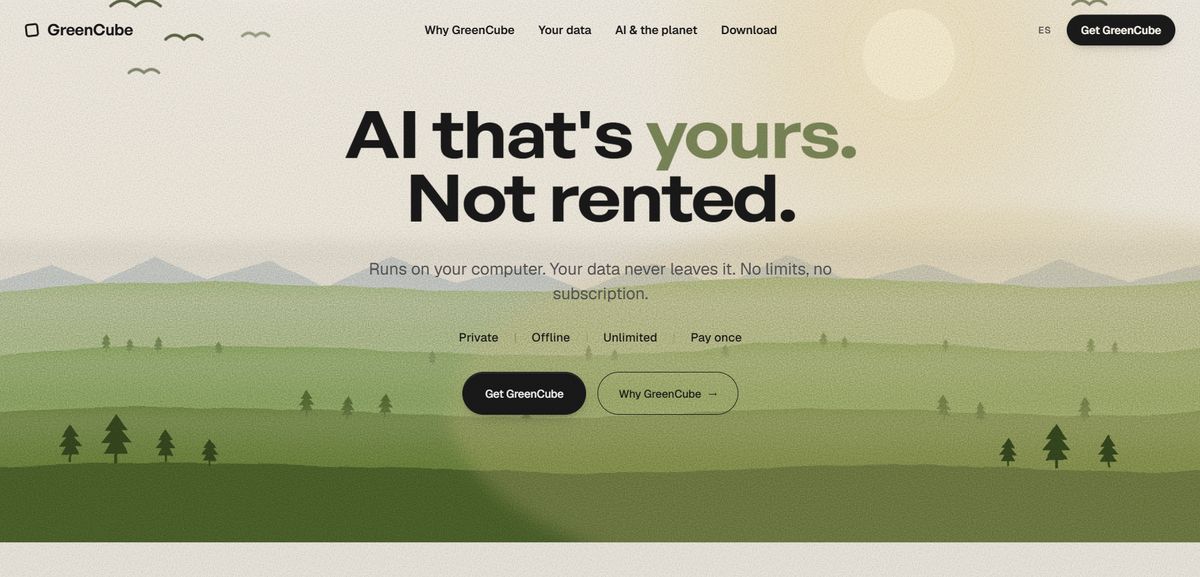
Setup takes minutes: sign in once with Google or Microsoft to verify your license (checkout runs through Stripe), pick between the smaller model for fast plain-text drafting or the bigger model if you need it to read images and PDFs, and download that one model file. From there, it works with zero internet connection and no usage limits. It won't out-reason a frontier cloud model on massive multi-document research, and it's honest about that trade-off, but for drafting, editing, and keeping unpublished work off someone else's servers, it does the job without a monthly bill.
Try it against your own manuscript for the full 15-day refund window and see whether the fit is right. Get GreenCube today and start your first offline draft this week.
Sources
- Lexicon (GitHub) — local-first editor with bundled models
- Novel Mage – Offline AI Novel Writing Software | No Subscription, No Cloud
- Sudowrite - Best AI Writing Partner for Fiction
FAQ
Do professional authors use AI?
Yes, a growing number of professional authors use AI tools for brainstorming, outlining, and drafting support, though most maintain a heavy editing pass to preserve their own voice and catch factual errors before publishing.
Which AI is better than ChatGPT for writing?
No single tool beats a general cloud assistant like ChatGPT on every task. Fiction-focused platforms like Sudowrite outperform it for story-specific features, while local tools like GreenCube outperform it on privacy and offline access for sensitive drafts.
Do professional writers use ChatGPT?
Many writers use ChatGPT or similar cloud tools for research summarization and idea generation, but privacy-conscious writers handling unpublished or contracted work increasingly pair it with, or replace it entirely with, offline tools that keep drafts off external servers.
Which GPT is best for writing?
There's no single "best" GPT model for every writer. Larger cloud models tend to handle complex reasoning and long documents better, while smaller local models, like the ones inside GreenCube, trade some of that power for full offline privacy and a one-time cost.
Is a local AI writing tool as capable as a cloud model?
Not for the largest, most complex reasoning tasks. Local tools trade some capability ceiling for privacy, offline access, and one-time pricing, which suits drafting and editing far better than heavy multi-document research.
Recommended
- The Best AI for Researchers: A Workflow-Based Guide
- Best AI for Lawyers: Practical Picks for Every Practice
- Best Private AI Assistant in 2026: Local and Offline
- Best Laptop AI Assistant for Privacy: Local and Offline
Your own AI, on your own PC
GreenCube runs on your computer: no usage limits, no subscription, works without internet. €9.99, paid once.
Get GreenCube