What are the best Poe alternatives right now?
The strongest poe alternatives in 2026 are Aymo AI, Monica, Typingmind AI, ChatLLM by Abacus AI, Perplexity AI, and Claude. Each one fixes a specific Poe pain point: compute point exhaustion, missing persistent memory, or weak integrations. Here is a quick orientation before the full breakdown:
- Aymo AI — 45+ models, BYOK support, affordable tiered plans; best for teams and power users
- Monica — browser-integrated multi-model access; best for everyday casual use
- Typingmind AI — 93 models, one-time purchase, no subscription anxiety; best for developers
- ChatLLM by Abacus AI — 100+ models, shared workspaces; best for professional teams
- Perplexity AI — citation-backed research answers; best for fact-checking and sourced queries
- Claude — long-form reasoning and document analysis; best for structured writing tasks
- Greencube — fully offline, one-time purchase, no cloud; best for privacy-first non-technical users
| Platform | Key Features | Best For | Pricing |
|---|---|---|---|
| Aymo AI | 45+ models, BYOK, PDF analysis | Teams, power users | Free; from $4/month |
| EaseMate AI | — | Students, marketers | — |
| MagAI | — | Agencies, marketing teams | From $20/month |
| ChatGPT | Persistent memory, broad utility | General-purpose daily use | Free; from $20/month |
| Gemini | Multi-modal, Google integration | Google ecosystem users | — |
| Claude | Long-form reasoning, document analysis | Complex writing and research | Free; from $17/month |
| Grok | Real-time knowledge, wide queries | Current events, broad queries | — |
| 1min.AI | Fast responses, simple UI | Quick interactions | Free; paid plans available |
| TESS AI | Enterprise security, scalable | Business AI integrations | Enterprise pricing |
| ClickUp | AI in project management | Teams wanting workflow AI | Free; from $7/user/month |
| GlobalGPT | 100+ models, low cost | Budget-conscious power users | From $11.90/month |
| Overchat AI | 150+ creative tools, unified UI | Chat plus image/video creation | From $14.99/month |
| Monica | Browser extension, multi-model | Everyday browser-based use | Free; from $9.90/month |
| Chatly | 40+ models, PDF, image gen | Content creators, mobile users | Free; from $7.50/month |
| Perplexity AI | Citations, source-backed answers | Research, fact-checking | Free; from $20/month |
| HuggingChat | Open-source, free, multi-model | Open-source enthusiasts | Free |
| Pi AI | Emotional intelligence, memory | Personal companion use | Free |
| AI Blaze | Productivity, creative tasks | Everyday varied AI tasks | Free; paid plans available |
| Typingmind AI | 93 models, BYOK, one-time buy | Developers, prompt engineers | From $39 one-time |
| Mammouth AI | 200+ file formats, multi-model | Heavy document users | From €10/month |
| T3 Chat | 10+ models, simple UI | Budget users, beginners | — |
| ChatLLM by Abacus AI | 100+ models, team workspaces | Enterprise, professional teams | From $10/user/month |
| ChatHub | Side-by-side model comparison | Model comparison tasks | From $19/month |
| LLM Gateway | API gateway, multi-model routing | Developers managing APIs | Usage-based pricing |
| AISpace | Persistent memory, integrations | Workflow management users | Paid plans available |
| Snack AI | Multi-domain knowledge, productivity | Broad knowledge tasks | Free; paid plans available |
| OpenRouter | Custom model orchestration, open API | Developers building bots | Usage-based pricing |
| LibreChat | Open-source, privacy-focused | Privacy-aware, self-hosters | Free (self-hosted) |
Why are users leaving Poe AI in 2026?
Poe, built by Quora, was a genuinely clever idea: one interface to access GPT, Claude, Gemini, and dozens of other models without juggling separate subscriptions. For experimentation, it still works. The problem is what happens when you try to use it for real work.

The compute point system is the biggest friction point. Poe cut its daily free allocation significantly in March 2026, which drastically reduced the number of usable conversations per day from dozens to just a few. Heavy users on the Standard plan report exhausting their monthly usage allowance very quickly when running Claude with extended context. Unused points do not roll over.
Then on may 25, 2026, Poe permanently shut down its Knowledge Base feature, deleting every file users had uploaded to power their custom bots. Bots that once pulled answers from your own documents became bare prompts overnight.
Beyond the point cuts, several structural limits push users toward alternatives:
- No persistent memory. Every new conversation starts from zero. Long-term projects require re-explaining context every session.
- Inconsistent model quality. Some users report that Poe's API implementations deliver inferior results compared to accessing models directly through their native interfaces.
- Weak integrations. No native connections to Gmail, Notion, Google Calendar, or file storage. Poe chats, not acts.
- No workspace organization. Chats cannot be tagged, searched, or exported to PDF or Markdown.
The pattern is clear: Poe suits exploration and model testing. Once your workflow stabilizes, its limits become the workflow.
Comprehensive comparison of the top Poe AI alternatives in 2026
The alternatives below split into recognizable categories: model hubs, persistent workspaces, research engines, developer tools, and privacy-first options. Knowing which category you need is half the decision.
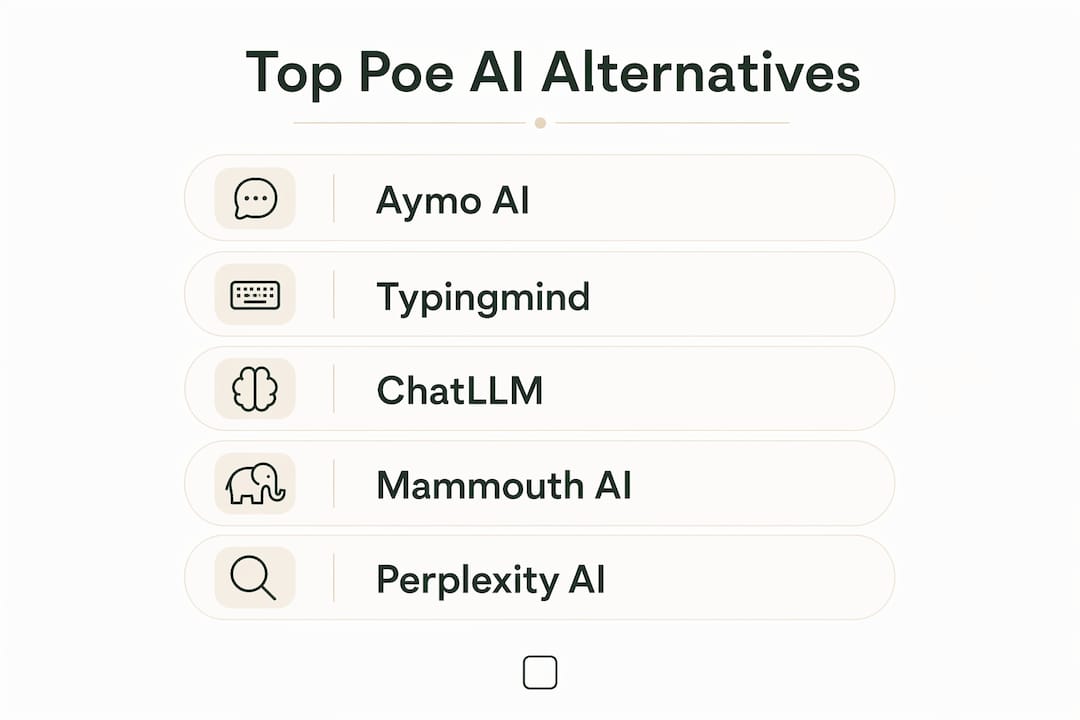
Aymo AI (formerly Greeky.chat) is the most practical all-around replacement for most Poe users. It gives you access to 45+ models including GPT, Claude, DeepSeek, Perplexity, and Qwen from one dashboard, with BYOK support so you control your own API costs rather than burning a platform's credits. Built-in PDF analysis and team chat-sharing make it genuinely useful for collaborative work. Plans start free and scale to $25/month for business use.

Typingmind AI is what Poe arguably should have stayed as. You pay once ($39–$99 one-time) and get access to 93 models including GPT, DeepSeek, Claude, Grok, Mistral, and Llama, with the ability to switch mid-conversation and compare answers side by side. There is no subscription, no points system, and no recurring anxiety about usage. The trade-off: no persistent workspace or memory system. It is a clean model-switching tool, not a project hub.
ChatLLM by Abacus AI leads on raw model count with 100+ options and adds shared workspaces and per-user pricing at $10/user/month. For professional teams that need predictable costs and collaborative AI access, it is the most structured option on this list.
Mammouth AI stands out for document-heavy workflows, supporting 200+ file formats for analysis. If your work involves processing varied file types alongside AI chat, nothing else on this list comes close.
ChatHub takes a different angle entirely: it lets you send one prompt to multiple models simultaneously and compare their responses side by side. It is not a workspace or a research tool. It is a comparison tool, and it does that one thing well. Plans start at $19/month.
Perplexity AI is the right pick when accuracy and sourcing matter more than conversation. It is built around search and citations from the ground up, and it shows. For fact-checking, quick research, and source-driven queries, it consistently outperforms general-purpose chatbots.
Claude handles long-form, document-heavy tasks better than most. It emphasizes clarity and coherence across extended outputs, which matters when you are editing a 10,000-word draft or working through complex structured analysis. Paid plans start at $17/month.
Monica is the easiest browser-based switch from Poe. The Chrome and Edge extension puts multi-model access inside your browser sidebar, with access to GPT, Claude, Gemini, and others. It has over 10 million users and raised a $75 million Series B in April 2026. Plans start at $9.90/month.
Chatly is mobile-first with 40+ models including GPT-5.5, Claude Opus 4.8, and Gemini 3.1 Pro. Context carries over when you switch models mid-conversation, which is a small but genuinely useful feature. At $7.50/month, it is one of the cheapest full-featured options.
GlobalGPT covers 100+ models across text, image, and video, adds new frontier models within 48 hours of release, and integrates Perplexity for research. It has over 2 million users, with more than 150,000 active daily. Starting at $11.90/month, it sits in the mid-range for cost.
Overchat AI is the strongest pick if you want chat plus creative media tools in one place. It runs the same frontier text models as Poe but adds 150+ purpose-built tools for image, video, and audio generation, each with a dedicated interface rather than a generic chat box. Trusted by over 350,000 users, it charges a flat $14.99/month.
T3 Chat strips things down to the basics: 10+ models, a clean interface, and a free tier that requires no credit card. For users who just want fast, accurate answers without setup complexity, it is the simplest entry point.
HuggingChat is free and open-source, connecting you to open-weight models through a simple web interface. It is best for experimentation and casual use, not for production workflows.
Pi AI takes a completely different approach, prioritizing emotional intelligence and personal interaction over raw capability. It remembers past conversations and responds with a conversational warmth that general-purpose models rarely match.
LibreChat and OpenRouter serve the self-hosting and developer end of the market. LibreChat is an open-source, privacy-conscious chat platform you can run on your own infrastructure. OpenRouter provides a flexible API backend for building custom multi-model bots and workflows. Neither is a consumer product out of the box, but both give developers full control.
LLM Gateway and AISpace round out the developer and workspace categories. LLM Gateway handles API routing across multiple model providers; AISpace focuses on persistent memory and workflow management for users who want a long-term AI workspace.
TESS AI targets enterprise deployments with security features and scalable integrations. ClickUp embeds AI directly into project management, making it the natural pick for teams already living in ClickUp's task system. 1min.AI, AI Blaze, and Snack AI each offer solid general-purpose multi-model access with varying emphases on speed, productivity, and knowledge breadth.
Pro Tip: Before committing to any platform, test your actual workflow in the new tool for a week. The best alternative is the one that needs the fewest follow-up prompts to get you to something usable.
How to choose the right Poe AI alternative for your needs
The most common mistake when switching from Poe is choosing the platform with the most models instead of the one that fixes your specific problem. Model count is a marketing number. Workflow fit is what you actually live with.
Start by identifying which Poe limitation broke your workflow:
- Points exhaustion → Typingmind AI (one-time purchase, BYOK) or T3 Chat (free tier, no points)
- No persistent memory → AISpace, ChatLLM by Abacus AI, or a workspace-oriented platform
- Lost Knowledge Base files → Back up immediately; migrate to Mammouth AI (200+ file formats) or Aymo AI (built-in PDF analysis)
- Weak integrations → ClickUp Brain for project management AI; platforms with MCP support for Gmail, Notion, and Dropbox connections
- Privacy concerns → LibreChat (self-hosted), OpenRouter (BYOK API), or Greencube (fully offline, covered below)
- Research and citations → Perplexity AI, no contest
- Team collaboration → ChatLLM by Abacus AI or MagAI for agency workflows
Pricing model matters as much as price. A $20/month flat subscription is predictable. A points system is not, especially if you use frontier models heavily. BYOK platforms like Typingmind AI and Aymo AI let you pay your model provider directly, which often works out cheaper for power users.
For workspace-oriented AI platforms, the key differentiator is multi-session memory. A true workspace stores project context, persona memory, and shared documents across conversations, so you are not rebuilding context every time you open a new chat. Poe never had this. If your work involves ongoing projects, that gap is the one worth solving first.
Before you switch, back up everything. Export your Poe conversation history, download any source files from bots, and test your core workflow in the new platform before canceling your Poe subscription. A MacBook workspace setup that integrates your new AI tool with your existing apps will smooth the transition considerably.
Greencube: the offline, privacy-first alternative for non-technical users
Every platform compared above sends your data to a cloud server. That is the fundamental trade-off of cloud AI: convenience in exchange for your prompts, documents, and conversations leaving your device.
Greencube takes the opposite approach. It is a downloadable desktop app that runs entirely on your own computer, with no cloud transmission of any kind. Your data never leaves your machine.
Key features that set it apart from every cloud-based aggregator:
- Fully offline operation — works without an internet connection once installed
- PDF and image analysis — read, summarize, and query documents locally
- Private chat — conversations stay on your device, period
- No account required — install and use immediately, no sign-up flow
- One-time purchase — no monthly subscription, no points, no renewal
- Non-technical friendly — no model setup, no Docker, no API keys to manage
The privacy gap between cloud platforms and local AI is real. Cloud AI services collect prompts to improve their models, and data handling practices vary significantly across providers. Greencube sidesteps that entirely: there is no backend to collect anything.
For users who were using Poe to process sensitive documents, client files, or personal research, the migration path to Greencube is straightforward. Download the app, move your files to your local machine, and start working. No migration wizard needed because there is no cloud account to transfer.
Greencube currently runs on Windows, with Mac support coming. It is a one-time purchase, not a subscription, which makes it the only option on this list that costs you nothing after the initial buy.
Greencube: a different kind of AI, entirely yours
If you have been paying monthly for cloud AI access and wondering what you actually own at the end of it, Greencube is worth a look.
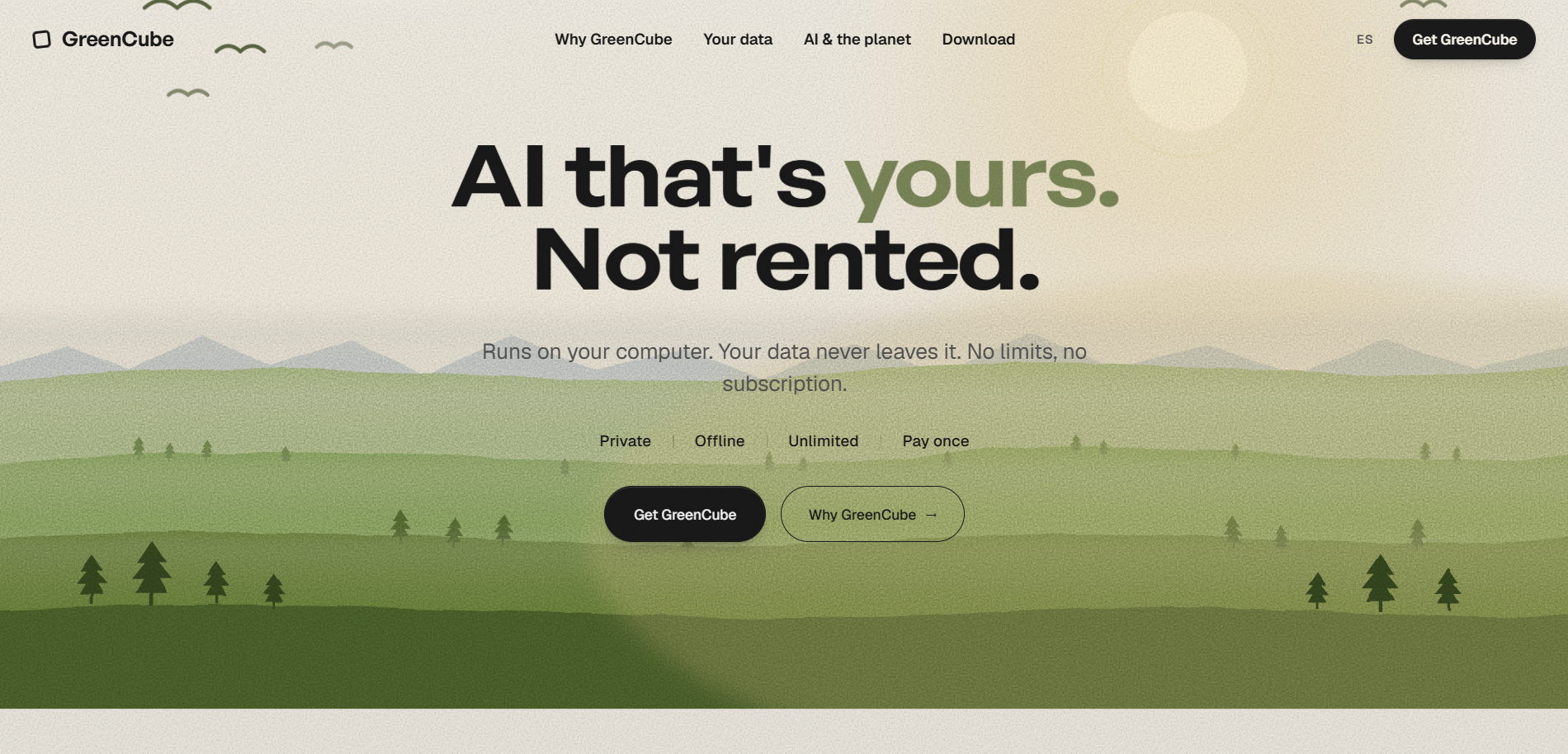
Every platform in this comparison rents you access to AI. Greencube sells you one. It runs on your computer, reads your PDFs, understands your images, and never phones home. No subscription, no account, no data leaving your desk. For non-technical users who want capable AI without the cloud trade-offs, that is a genuinely different proposition from anything else on this list.
The one-time purchase covers a lifetime license. You pay once, you own it. If you are tired of watching a points balance drain or wondering what a platform does with your documents, Greencube offers a clean exit from that cycle. Visit greencube.app to see how it works.
FAQ
What is the best free Poe AI alternative?
T3 Chat and HuggingChat both offer genuinely usable free tiers with no credit card required. Aymo AI's free plan also includes access to multiple models without an aggressive paywall.
Which Poe alternative has the most AI models?
ChatLLM by Abacus AI offers access to 100+ models, the largest count among mainstream platforms. Typingmind AI follows with 93 models.
Is there a Poe alternative without a points or subscription system?
Typingmind AI uses a one-time purchase model ($39–$99) with no recurring fees or points. Greencube also uses a one-time purchase and runs fully offline, eliminating both subscriptions and cloud rate limits.
Which alternative is best for teams and agencies?
MagAI is built specifically for agency and marketing workflows with custom persona management and client workflow integrations. ChatLLM by Abacus AI is the stronger pick for larger enterprise teams that need shared workspaces and predictable per-user pricing.
Can I recover files from Poe's Knowledge Base after the May 2026 shutdown?
No. Poe's Knowledge Base shutdown on May 25, 2026 was permanent, and there is no official recovery path for files deleted after that date. If you still have active Poe access, back up source files immediately.
Key Takeaways
The strongest Poe alternatives in 2026 fix specific workflow problems: points exhaustion, missing memory, weak integrations, or privacy gaps.
| Point | Details |
|---|---|
| Match the tool to your problem | Choose based on the Poe limitation that broke your workflow, not on model count alone. |
| Persistent memory changes everything | Workspace-oriented platforms store context across sessions, eliminating constant re-explanation. |
| Pricing model matters more than price | Flat subscriptions and one-time purchases beat unpredictable points systems for daily use. |
| Privacy has a real alternative | Greencube runs fully offline with a one-time purchase, keeping all data on your own device. |
| Back up before you switch | Poe's Knowledge Base deletion was permanent; export all files before migrating to any alternative. |