
If you want a private, offline AI for your documents and images with a one-time payment, Greencube is the clear pick. Humata AI is the cloud-based reference point most people start with, but it uploads your files to remote servers and runs on a subscription. Greencube does the opposite.
Here is why Greencube fits the brief:
- Fully offline. Everything runs on your own computer. Nothing is sent to any server, ever.
- One-time license. Pay once, use it forever. No monthly bill, no usage caps, no freemium traps.
- PDF and image analysis out of the box. Built-in OCR handles scanned pages and photos without extra software or configuration.
Table of Contents
- What are the best Humata AI alternatives for offline, private use?
- Greencube: why it fits your constraints better than any cloud service
- What Humata gives you — and where it falls short for privacy-first users
- Other approaches you will encounter during your search
- How to pick the right alternative for your workflow
- How to switch from Humata to an offline desktop app
- Practical limitations of offline desktop AI you should know
- What switching typically costs in money and time
- Key Takeaways
- Why offline-first AI is the honest choice
- Greencube: a private, offline alternative to Humata worth trying
- FAQ
What are the best Humata AI alternatives for offline, private use?
The table below maps Greencube against Humata and three broad alternative approaches you will encounter during research. Values are short and practical so you can rule options in or out quickly.
| Dimension | Greencube | Humata AI | In-browser readers | Cloud PDF chat services | Self-hosted local LLM frontends |
|---|---|---|---|---|---|
| Best for | Private doc + image analysis, non-technical users | Multi-PDF Q&A with citations | Reading docs where they live | Quick cloud-based Q&A | Power users who want local control |
| Pricing model | One-time | Freemium / subscription | Free or freemium | Freemium / subscription | Free (hardware cost) |
| Offline capability | Fully offline | Cloud only | Partial (browser-based) | Cloud only | Fully offline |
| Ease of use (non-technical) | High | Medium | High | Medium | Low |
| Supported files | PDF, images, scanned docs | PDF (multi-doc) | PDF, web pages | PDF, some Office | Varies by setup |
| Platform | Windows (Mac coming) | Web | Web / browser extension | Web | Windows, Mac, Linux |
| Data ownership | Files stay on device | Files uploaded to cloud | Varies | Files uploaded to cloud | Files stay on device |
| Typical hardware | Modern laptop (8 GB RAM) | Any device with browser | Any device with browser | Any device with browser | High-spec PC (16+ GB RAM) |
| Time to set up | Minutes | Seconds (account required) | Seconds | Seconds (account required) | Hours to days |
Note: "In-browser readers" like Sidenote read documents where they live without a file upload, which is different from upload-first cloud services. Self-hosted frontends are offline but require significant technical setup.
Greencube: why it fits your constraints better than any cloud service
Greencube is built around one idea: your files stay on your machine. That is not a marketing line. The app has no network calls for document processing. Open a PDF or drop in a scanned image, ask a question in plain English, and get an answer. No account creation, no model selection, no prompt engineering.
Core features at a glance:
- Local document and image analysis with natural-language Q&A
- Built-in OCR for scanned pages and photos, automatic and accurate
- No account required, no cloud sign-in, no setup wizard
- Windows app available now; Mac version in development
Privacy. Because Greencube runs entirely offline, your documents never touch a third-party server. That matters most when the files contain medical records, legal contracts, financial statements, or anything you would not email to a stranger.
Pricing. Greencube is a one-time purchase. The lifetime license covers unlimited usage with no page caps and no per-answer charges. Freemium economics on cloud services often obscure long-term costs; a one-time purchase removes that unpredictability entirely.

Hardware. A modern Windows laptop with 8 GB of RAM is enough to get started. Performance scales with available memory, so 16 GB gives noticeably faster responses on large documents.
Pro Tip: Drop a single scanned page into Greencube before importing your full library. Confirm the OCR output looks accurate, then proceed. This takes two minutes and saves confusion later.
What Humata gives you — and where it falls short for privacy-first users
Humata's core workflow is straightforward: upload PDFs, ask questions across multiple documents, and get answers with citation highlights that point back to the source paragraph. For reading comprehension and multi-document Q&A, Humata performs well and its citation granularity is a genuine strength.
The trade-offs are real, though:
- Cloud uploads. Every file you analyze passes through Humata's servers. For sensitive documents, that is a non-starter.
- Freemium limits. The free plan has usage limits that restrict the number of pages and answers. Heavy users hit those limits fast and move to paid tiers.
- Subscription dependency. Costs scale with usage, and pricing overages are a common reason users start looking for alternatives.
- No offline mode. If your internet drops or you are working on a plane, Humata stops working.
Pro Tip: Humata makes sense when you need real-time collaboration on shared documents or integrations with cloud storage. If your workflow is solo and your files are sensitive, a local desktop app is the better fit.
Other approaches you will encounter during your search
Not every alternative is a desktop app. Here is a quick map of the categories:
In-browser readers let you read documents where they already live, sometimes without uploading anything. They are convenient but depend on a browser and often a live connection.
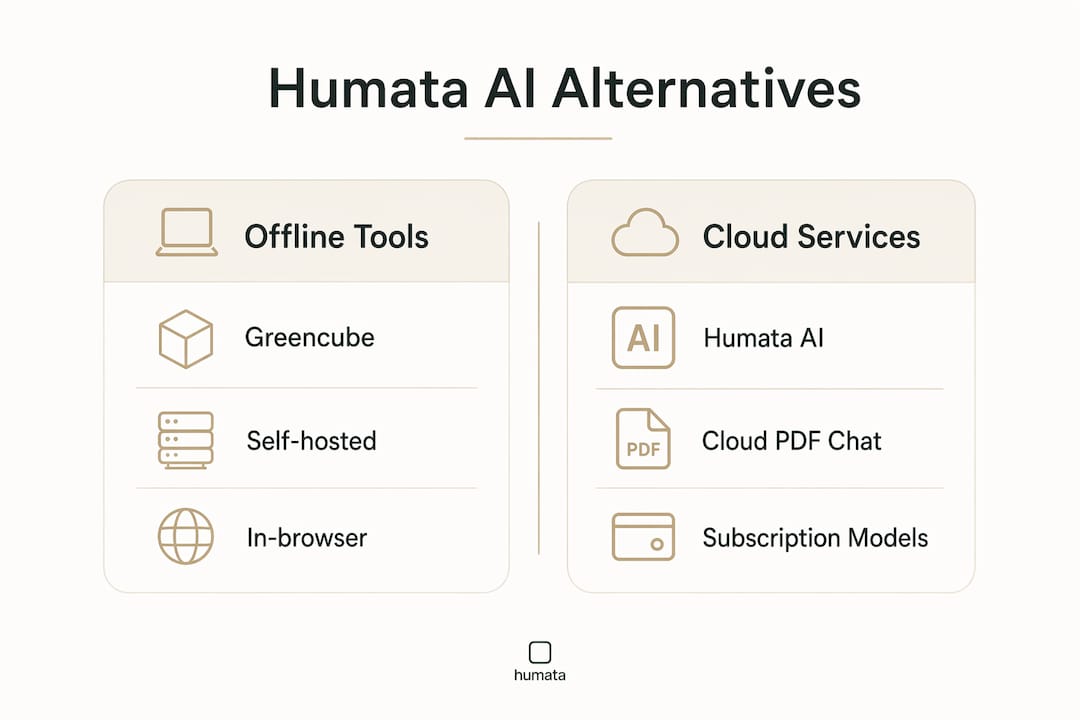
Cloud PDF chat services are the most common Humata alternatives in roundup lists. They are fast to start but share the same fundamental issue: your files leave your device. Free tiers frequently impose page or file-size limits that interrupt workflows at the worst moments.
Self-hosted local LLM frontends are fully offline and can be very powerful. The catch is the setup. Configuring a local model, managing dependencies, and tuning performance requires comfort with command-line tools and often a high-spec machine with 16 GB or more of RAM.
Matching a tool to your workflow matters more than feature counts. If your content lives in a wiki, Notion, or the live web, an upload-first tool won't help unless it provides direct integrations. If your content is local files, a desktop app is the natural fit.
For non-technical users who want privacy without the setup burden, self-hosted options are a poor fit. The technical barrier is high enough that most people abandon the process before getting a useful result.
How to pick the right alternative for your workflow
Work through these questions before committing to any tool:
- Do you need fully offline operation? If yes, eliminate every cloud service immediately.
- Is a one-time payment mandatory? If yes, eliminate every subscription and freemium tool.
- Do you need OCR for scanned images or photos? If yes, confirm the tool handles this automatically, without manual configuration.
- Are you comfortable with technical setup? If no, eliminate self-hosted local LLM frontends.
- Do you need cloud integrations or real-time collaboration? If yes, a desktop app may not cover everything you need.
For most readers here, questions 1 through 4 point to a fully offline desktop app with built-in OCR and a one-time license. That is Greencube.
How to verify offline claims. Open the app, disconnect your internet, and try to analyze a document. If it works, the offline claim is real. Also check the data-use policy for any language about training on user content. A trustworthy offline app has no mechanism to collect that data in the first place.
Pro Tip: Search the privacy policy for the words "training," "improve our models," and "third party." Cloud services often reserve the right to use uploaded content for model improvement. Offline apps with no network access cannot do this by design.
How to switch from Humata to an offline desktop app
- Export your documents. Download all files from your Humata account before closing it. Humata stores uploaded PDFs; retrieve them from your account dashboard.
- Organize files locally. Create a simple folder structure on your computer before importing. Flat folders by topic or project work well.
- Install Greencube. The installer runs in minutes. No account, no activation key, no internet required after download.
- Run a test import. Drop one document into the app and ask a basic question. Confirm the answer is accurate before importing your full library.
- Verify no uploads occur. Disconnect your internet after installation and confirm the app still works normally. It will.
For scanned documents, run the OCR pass on a representative sample first and check the text output for accuracy before asking complex questions.
Pro Tip: Keep a local encrypted backup of your document library separate from the app. A tool like VeraCrypt or your operating system's built-in encryption covers this without cloud involvement.
Practical limitations of offline desktop AI you should know
Offline apps are not perfect substitutes for cloud services in every scenario. Here is what to expect:
- Model updates are manual. Cloud services push model improvements automatically. Desktop apps require you to update the software yourself.
- No live web access. The app cannot browse the internet or pull in real-time data. It works only with files you provide.
- Collaboration is limited. Offline apps are single-user by design. Sharing insights requires exporting results manually.
- Hardware matters. On a laptop with 8 GB of RAM, large documents may process more slowly than a cloud service. Upgrading to 16 GB makes a meaningful difference.
- Model capability may lag slightly. The most cutting-edge language model capabilities often appear in cloud services first. Offline apps close the gap quickly, but there is usually a short lag.
For AI document risk analysis or compliance workflows, pairing an offline desktop app with a specialized document risk tool can cover gaps that a general-purpose app leaves open.
What switching typically costs in money and time
Greencube's one-time license is priced at €9, which covers lifetime use with no recurring charges. That is the full cost of the software.
| Cost item | Typical range | Notes |
|---|---|---|
| Greencube license | €9 (one-time) | Lifetime, unlimited use |
| Hardware upgrade (optional) | Usually unnecessary | Only if RAM is below 8 GB |
| Setup time | 10–30 minutes | Install, test document, first query |
| Library import time | 1–8 hours | Depends on collection size and OCR volume |
Hidden costs on cloud services add up differently. A freemium plan that caps pages forces an upgrade; subscriptions compound monthly. A lifetime license sidesteps that entirely.
Key Takeaways
Greencube is the strongest Humata AI alternative for non-technical users who need private, offline document and image analysis with a one-time payment and no technical setup.
| Point | Details |
|---|---|
| Offline operation is the core filter | Any tool that uploads files to a server fails the privacy test for sensitive documents. |
| One-time pricing beats freemium long-term | Freemium caps on pages and answers create hidden costs; a lifetime license removes that unpredictability. |
| OCR must be automatic | Non-technical users need scanned image support without manual configuration or extra software. |
| Self-hosted options require technical skill | Local LLM frontends are private but demand setup time and higher-spec hardware most users don't have. |
| Greencube fits all four constraints | Fully offline, one-time license at €9, built-in OCR, and no account or model setup required. |
Why offline-first AI is the honest choice
The privacy conversation around cloud AI tends to focus on data breaches, but the more common risk is quieter: you upload a sensitive file, agree to a terms-of-service document you did not read, and your content becomes part of a training pipeline. That is not a hypothetical. It is how most cloud services are structured.
Greencube was built from the opposite assumption. If the app cannot send data anywhere, it cannot misuse it. That is a design constraint, not a policy promise. Greencube also publishes transparent material on AI's environmental footprint because the same cloud infrastructure that creates privacy risk also carries a real resource cost. Offline processing eliminates both.
For non-technical users, the other half of the equation is simplicity. A tool that requires model selection, prompt templates, or API keys is not actually accessible to most people. Greencube installs like any other app and works immediately. That combination of privacy and usability is what the category has been missing.
Greencube: a private, offline alternative to Humata worth trying
Cloud PDF tools are convenient until they are not. The moment you have a document you would not want on someone else's server, the convenience argument collapses. Greencube gives you the same core capability — chat with PDFs, analyze images, get answers in plain English — without any of that exposure.
The one-time license costs €9 and covers unlimited use with no subscription. Installation takes under 30 minutes, and your first useful query can happen the same day. If you have a library of scanned documents, budget a few hours for the OCR pass. After that, the app runs without an internet connection, without an account, and without any ongoing cost.
Ready to try it? Visit Greencube to download the app and get started.
FAQ
Is Greencube fully offline with no data sent to the cloud?
Yes. Greencube runs entirely on your computer and has no mechanism to upload files or send data to any server. Your documents stay on your device.
How does Greencube's pricing compare to Humata AI?
Greencube is a one-time purchase at €9 for a lifetime license. Humata AI uses a freemium model with usage limits on the free plan and paid subscriptions for heavier use.
Can Greencube handle scanned PDFs and images?
Yes. Greencube includes built-in OCR that processes scanned pages and photos automatically, without any manual configuration or third-party software.
What hardware do I need to run an offline desktop AI app?
A modern Windows laptop with at least 8 GB of RAM is enough to run Greencube. Upgrading to 16 GB improves performance noticeably on large documents.
When does a cloud service like Humata make more sense than a desktop app?
Cloud services are better suited for real-time collaboration, shared document workflows, or when you need integrations with cloud storage platforms. If privacy and offline access are priorities, a local desktop app is the stronger choice.